Above we have the home of Lizzie Borden in Fall River, Massachusetts. It has become, since its transformation in the last decade from a private home to a museum and bed & breakfast, a major tourist attraction in Fall River.
 The side door, from which Lizzie called for help upon discovering her father's murdered body.
In a way, it represents the gradual transformation over the last century of the story of Lizzie Borden from grisly homicide, to Victorian media scandal, to hushed community secret, to the object of bad jokes and morbid puns, to the never-ending fascination with unsolved mysteries.
 The dining room, where Lizzie allegedly ironed while her stepmother was murdered in the room directly above her.
Very few of the furnishings and artifacts in the home are original to the period of when Lizzie Borden lived here, but the current owners have restored and refurbished the house to replicate photographs of the rooms, and have filled nearly every nook and cranny with items relative to the strange case of Lizzie Borden, from the “class reunion” photo in the dining room of the jury that acquitted her, to the photos of the family members and trial participants who were all characters in this most dramatic crime and ensuing trial. We are treated to what life was like not only in this house, but in Fall River toward the end of the 19th Century.
 The sitting room, where Mr. Borden was murdered.
In 1892, Andrew Borden, a very wealthy man, lived with his second wife and his two grown daughters by his first marriage in a more modest section of Fall River. He bore the name of one of Fall River’s prominent families, and represented the eighth generation of Bordens living in the community. However wealthy they were, Andrew was not born to wealth in his branch of the family tree, but worked at a succession of careers until he fashioned himself a very wealthy banker. By all accounts a dour, miserly man, Andrew eschewed the company of the wealthier relatives who lived up The Hill in mansions with running water, toilets, gas lighting, etc., and continued to live in this ramshackle house on Second Avenue without any modern conveniences because he was not willing to pay for them, despite being quite rich.
 The guest bedroom where Lizzie's Uncle John slept the night before (and after) the murders; the room where Mrs. Borden was killed.
Here, he and his wife, stepmother to his daughters Emma and Lizzie, were murdered one August morning. There has been much conjecture over the decades about who did it, how, and why, and some of the theories are quite fascinating, some outlandish. I won’t go into them here, but Lizzie was arrested for the crime, and held in jail awaiting trial for several months. Finally in the spring of the following year, she was tried for the murder of her father and stepmother. The jury found her not guilty.
 Lizzie's bedroom.
That didn’t stop Fall River from ostracizing Lizzie shortly after the outcome, though she had been something of a hero and a martyr while she was imprisoned. The acquittal did not stop somebody from making up that now famous rhyme,
“Lizzie Borden took an axe and gave her mother 40 whacks” etc.
 A sketch of Lizzie and her lead attorney, George Robinson, in court, drawn on the spot by G. West Clinedinst (Libarary of Congress).
It didn’t stop anybody from writing a number of books, a couple of plays, a ballet, a Broadway review (“You can’t chop your papa up in Massachusetts…”) and a made for television movie which all inferred she was actually guilty.

Incidentally, a costume worn by the actress Elizabeth Montgomery who played Lizzie in “The Legend of Lizzie Borden” (1975), currently on loan from Paramount, is on display in the guest bedroom (where Mrs. Borden was murdered), along with a still photograph of Ms. Montgomery in the movie.
 The parlor, where Lizzie was informed she was a suspect in the crime.
We see the kind of handkerchief Lizzie was allegedly ironing at the tabletop ironing board, flat iron at the ready, at the moment her stepmother was murdered. We see the kind of bedroom door key Andrew Borden placed on the mantle as he napped on the kind of couch he would have napped on when he was hatcheted to death in the sitting room. We see the kind of piece of wood he kept near the head of his bed as a weapon because he feared business enemies and irate tenants in his properties who might try to kill him in his sleep.
 We see the replica hatchet in the wood box by the replica stove in the kitchen. Pay no attention to that. It’s just a prop. Don’t let it give you any ideas.
 After her acquittal, Lizzie and Emma moved up The Hill to a nice house where the rich people lived, but Fall River continued to regard Lizzie and everything about her as an insult and embarrassment to the town. Lizzie, in what must have been a stubbornness that was a mixture of the comical and the tragic, thumbed her nose at the town in return, in part by simply not going away.
 Here is a photo of the home she lived in the remainder of her life, which she christened “Maplecroft” and carved it, to the disgust of her disapproving neighbors, on the steps for everyone to see. If you visit Fall River in search of Lizzie Borden sites, please remember this home on French Street is privately owned. I imagine the owners must be sick of people driving by to glance at the house, but do not trespass.
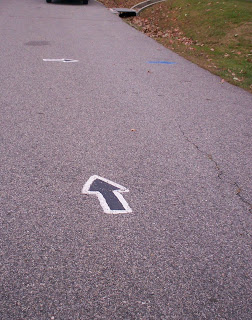
If you’ve come this far, you might as well head on up to Oak Grove Cemetery, where the entire Borden clan is buried together. Arrows are painted on the winding cemetery drive to direct you to the Borden plot. I imagine it would have made Lizzie smile to find herself so famous as to require signposts to her grave.
 Others in the cemetery might be turning over in theirs at the thought of it.
 In the 1938 “WPA Guide to Massachusetts”, which gives us a wealth of detail on towns and cities in Massachusetts at the end of the Great Depression, the description of Fall River, its history and tourist attractions, discreetly makes no mention at all of Lizzie Borden, even then easily the town’s most famous citizen. Perhaps the town refused to talk. At the time this book was published, it had been some 11 years after her death. The Victorian sense of propriety which had made the murder and its acquitted accused such a scandal was beginning to fade. But not enough to where Lizzie Borden could be turned into a tourist attraction.

Fast forward to now. The garage behind the Lizzie Borden house, which was once the site of the infamous barn where Lizzie allegedly hunted for lead sinkers and ate pears while murder was being committed, is today the office and gift shop of the Lizzie Borden Bed & Breakfast. You can buy souvenirs here, many of which seem to have a hatchet theme.
The guided tours last about 45 minutes and are conducted in the afternoons. After which, the overnight guests arrive and are treated to private tours. The house, despite Andrew Borden’s tightfistedness, is now equipped with modern conveniences, though appointed to look very 19th century.

The guide on the tour I took was young, very knowledgeable, and quite funny. She took a lot of the creepiness out of the whole experience. The house, though it is the scene of a ghastly double-murder, beyond that horrific tragedy represents a lot of what was present in Fall River as a wealthy 19th century New England community. At the time, it was among New England’s most renown cities for cotton manufacturing, rivaling Lowell and other mill towns.
The relocation of the manufacturing firms to the South, (and subsequently overseas), as well as the Great Depression finished off that era in Fall River’s timeline, and there is little left on this end of Second Street to illustrate what life was like on that August day in 1892 outside the Borden home. Time moves on, as it should.
But inside the house, that’s a different story. Victorian intrigue awaits, and the irresistibly intriguing realization that whoever committed this crime among the known persons involved in the cast of characters, including Lizzie, her visiting maternal uncle John Morse, Bridget the maid, or the disgruntled illegitimate son of Andrew Borden, or any of Mr. Borden’s supposed enemies, got away with it. The mystery has never been solved.

For more on the Lizzie Borden Bed & Breakfast, have a look at this website. For more on the story of Lizzie Borden, have a look at The Hatchet website for continuing investigation into the mystery.
And here, for the transcripts of the trial depositions. Also, the Fall River Historical Society is a valuable resource for information on the Lizzie Borden case.