Affiliate notice

Affiliate links may be included in posts, as on sidebar ads, for which compensation may be received.
Showing posts with label disasters. Show all posts

Monday, February 12, 2024

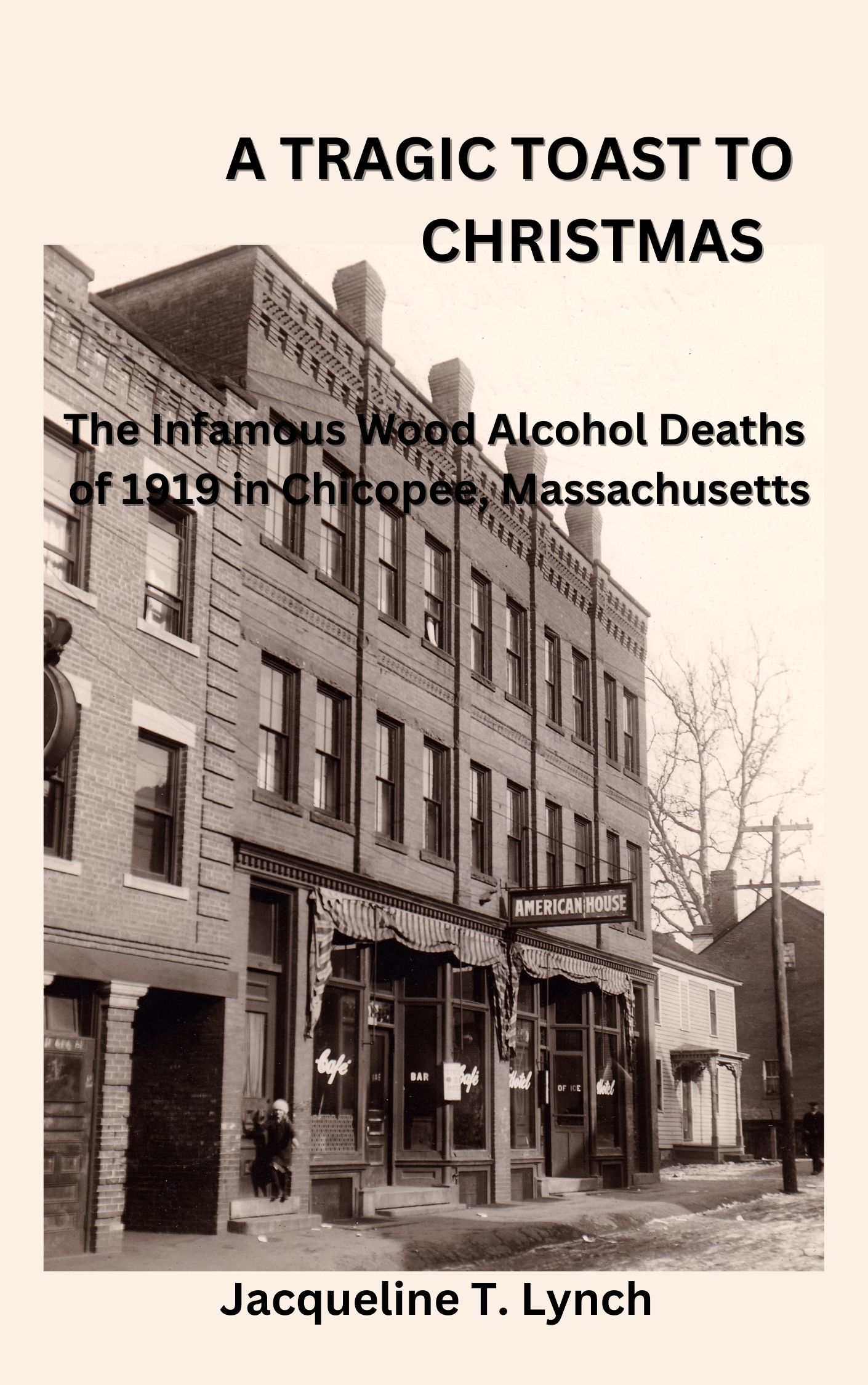
A Tragic Toast to Christmas - wood alcohol deaths of 1919 in Chicopee, Mass.


More than 100 people died of a companionable drink in several towns and cities in New England on Christmas Eve and Christmas Day 1919, nearly half of them in the city of Chicopee, Massachusetts. How this came to happen, and even how it came to be forgotten are both intriguing aspects to the tragedy.


The story of the grisly incident of unknowingly ingesting poisonous wood alcohol and how it played out in one New England city might stand as a microcosm of the conflict created between the legal production and sale of alcohol, those who would prohibit it, and those who would do anything to profit from it, not only in the years up to 1919, but in the tumultuous decade that followed.


Tuesday, November 19, 2013

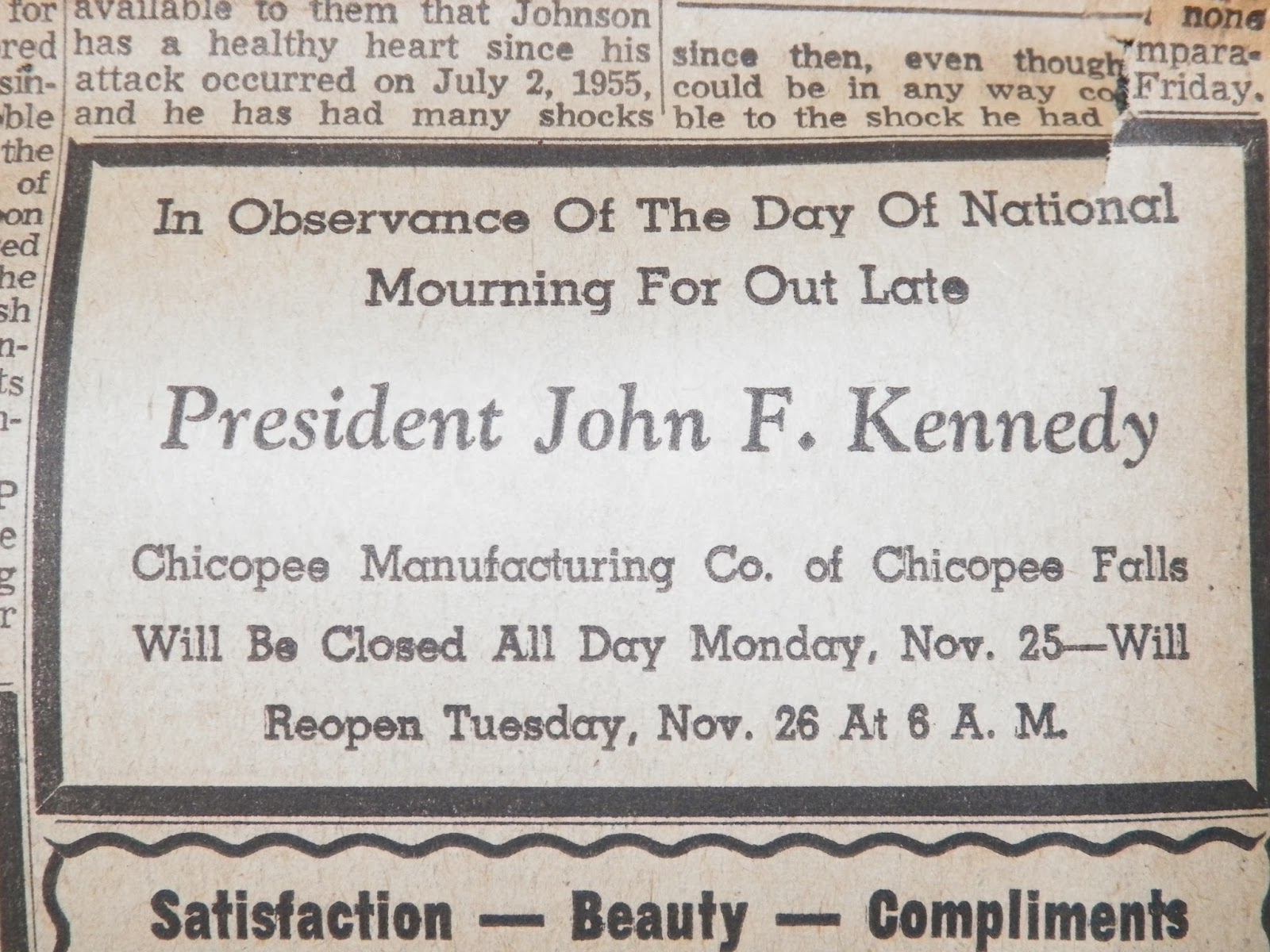
JFK - A 50th Anniversary


Fifty years is a long time, but still only the blink of an eye in the measure of eras, only one small thread in the enormous tapestry of history.  We see this event, this assassination, as the beginning of our modern, cynical, chaotic era, and most who remember the day--indeed, that entire waking nightmare weekend--remember not just the news but where they were, what they were doing, who they were at that time, fitting themselves into the larger context of national history.


It happened on Friday.  By the time Monday morning arrived to a bleak new world, we had suffered the shock of assassination, the agony of a young widow, been stunned at another murder on live television, and had in the course of it all become newly educated on the protocol of personal, communal, and national mourning.  Our world shut down for one day at the end of it in tribute, honor, and respect--and something more; a desire simply to pause and reflect before the world--as we suspected it might--got even crazier.


The newspapers (shown here from three different Springfield, Massachusetts, papers) are yellowed and fragile with age, but their images and words are still overwhelming.


Tuesday, October 9, 2012

West Cornwall Covered Bridge - Connecticut


The iconic red bridge has known its lonely moments, but this is not one of them. On a spanking fresh fall day, the West Cornwall Covered Bridge in West Cornwall, Connecticut is likely to be the scene of converging leaf-peepers with cameras.

Open to vehicular traffic, a minor traffic jam might occur when someone takes a little extra time to get that perfect shot.


Bridges were placed on this spot over the Housatonic River as early as the 1760s, but floods and ice swept them away. This present bridge was reckoned to have been built about 1864. It had been gray colored until 1957, when it was first painted red and took on the image of typical New England tourist brochure. According to the ConnecticutHistory.org site mentioned below, the producers of the 1967 film, “Valley of the Dolls” used a shot of the bridge at the opening of the movie to represent an idyllic New England town.


Fame didn’t go to the bridge’s head. It’s still willing to mingle among the little people, it’s adoring fans, who cluster under its roof timbers and line up along the banks of the Housatonic as they set up for that perfect photo.


A covered bridge is a precarious structure. This one has been threatened (what hasn’t?) by the Hurricane of 1938, the 1955 flood, and a 1961 ice jam. An effort by the community in 1968 to save and preserve the bridge received the help of the Connecticut Department of Transportation to raise the bridge and insert a steel support under the roadway. Today it is listed on the National Register of Historic Places.

If you happen to be meandering through western Connecticut, have a look at West Cornwall’s lovely bridge. If it’s a sunny, leaf-peeping weekend and others have gotten there first, don’t mind. Get out your camera. You’ll get your turn. In the meantime, listen to the splash of the Housatonic on the stones below, and breathe the fresh air. It’s a good spot for a rest.


For more on the West Cornwall Covered Bridge, have a look at this West Cornwall Historical Society site, and this site for ConnecticutHistory.org.

Tuesday, April 17, 2012

Titanic Centennial Memorial - Springfield, Massachusetts

This coming Saturday, April 21st, the Titanic Historical Society of Indian Orchard, Massachusetts is dedicating a new memorial to two of the victims of the sinking of the RMS Titanic. Oak Grove Cemetery in Springfield is the site of the Titanic Centennial Memorial.

Two individuals from Springfield were lost in the tragedy: Milton C. Long, the only son of a former mayor of Springfield, who was 29 years old; and Jane Carr, who was an Irish-born domestic and cook, 47 years old. She had worked in Springfield, and at the Chicopee Falls Hotel. Long was a first-class passenger, and Carr was third class.

Milton Long’s body was recovered and is buried in Springfield Cemetery. It is unknown if Carr’s remains were ever recovered.

Edward S. Kamuda, president and founder of the Titanic Historical Society, began the organization and unique museum of artifacts after seeing the “Titanic” 1953 film at the Grand Theater in Indian Orchard. More on the museum here in this previous post. For a look at the 1953 film, visit yesterday’s Another Old Movie Blog post here.

Friday, August 20, 2010

The Flood of 1955


(Don't forget to scroll down to the bottom of this page to mute the music so you can hear the newsreel.)


The Flood of 1955 came from the residual rain of two hurricanes, and yet because of its suddenness in striking in the wee hours on August 19th, seemed to come out of nowhere.

Hurricane Connie, and Hurricane Diane, neither of which actually entered New England, nevertheless pushed a couple of feet of rain, a deluge in a very short span of just over a day. The sodden ground could take no more, and the rivers morphed into monsters and took property, and lives, away.

There seemed to be less havoc on the Connecticut River, which had the benefit of flood control projects inspired by previous flood disasters, but the smaller rivers and tributaries were not protected quite so well.

The Westfield River in Western Massachusetts, and especially down the Naugatuck River valley, Connecticut’s industrial center, was hammered by the swift, destructive current. In Connecticut, over 90 people were dead or missing and presumed dead. In a report in the Connecticut State Library, “The Connecticut Floods of 1955: A Fifty-Year Perspective” we note that over 85,000 people were left without jobs, several thousand suffered flood damage to their homes, or were temporarily left homeless, or lost their homes altogether.

Another flood in October would make 1955 a very memorable and tragic year for Connecticut. In these days before suburban industrial parks, most industries were built on, and were powered by, rivers. Our towns created by the rivers in the 16th and 17th centuries still thrived as 20th century “downtowns” where most of the commerce, if not still many of the homes before suburban sprawl, were situated.

There is a duality to rivers. They give birth to communities, and whole civilizations; and they sometimes take it away.

Have a look here for facts and figures, and photos, of the Connecticut flooding in this Connecticut State Library site, a 50-year perspective on the 1955 floods. Have a look here for a series of articles by Jim Shea of The Hartford Courant also done on the 50th anniversary in 2005, particularly for the vivid memories shared by readers.

Also have a look here for a Western Massachusetts perspective from one of my favorite blogs, On Larch Lane.

And here on yesterday’s Another Old Movie Blog, we discuss Rosalind Russell’s movie premiere and homecoming to her hometown of Waterbury, Connecticut hours before the flood destroyed much of the aptly named Waterbury.

Tuesday, August 3, 2010

The Wreck of the SS Andrea Doria


In late July 1956, the ocean liner SS Andrea Doria sank on the last night of its transatlantic voyage from Italy to New York City when another ocean liner, the MS Stockholm, collided with her.

It seemed a watershed moment, almost as if morosely heralding the end of the leisurely elegance of ship travel (the first jet was to cross the Atlantic two years later), and the beginning of instant news as still photographers from Life magazine and others, newsreel cameramen, and reporters scrambled to the site to watch the vessel sink. Topping any newspaper “extras,” the film was developed and shown on television.

Most amazing about the story of the sinking of the Andrea Doria is rescue operation that began in such an impromptu fashion, among a variety of vessels and participants, and became one of the most successful rescues at sea in history. The death toll of 46 from the Andrea Doria and 5 from the Stockholm was a tragedy. That there were not more was a triumph.

Much of the information from this post comes from Richard Goldstein’s fine book Desperate Hours - The Epic Rescue of the Andrea Doria (John Wiley & Sons, Inc., NY, 2003), as well as the interesting television documentary, Secrets of the Dead - The Sinking of the Andrea Doria (PBS 2006).

Her last voyage was to be a nine-day journey from Genoa, Italy to New York City in this era where travel was leisurely. The trip enjoyed clear weather, and a peaceful crossing until its final night when disaster struck off the New England coast.

An excellent book called Shipwrecks Around Cape Cod by William P. Quinn (Lower Cape Publishing, Orleans, Mass. 1973), notes centuries of nautical disasters off the shores of Cape Cod where a variety of circumstances have made these treacherous waters. Survival rates, in days long gone by, were not very good.

Safety, and chances of survival, had improved a very great deal by the summer of 1956 when the Andrea Doria was completing her pleasant journey across the Atlantic. But a hurdle had been thrown out by the typically unforgiving New England weather on this last evening of the voyage, the notoriously fog-bound waters south of Nantucket.

There was the usual last night festivities on ship, with champagne and streamers, and a roast beef dinner, and “Arrivederci Roma” played by Dino Massa and Orchestra. Shortly after 11 p.m., the MS Stockholm accidentally rammed the Andrea Doria, and a drama of several hours began.

Ten minutes after the collision, a ship-to-shore radio station in Chatham, Massachusetts on the Cape received a distress call, first from the Stockholm, and immediately followed by the Andrea Doria. Closest to the scene were six other ships: a commercial freighter called Cape Ann; a military transport Private William H. Thomas; the Coast Guard cutter Hornbeam; a Navy destroyer escort ship Edward H. Allen; and a tanker, the Robert E. Hopkins; as well as another grand ocean liner, the Ile de France.

Fortunately, though the Stockholm was severely damaged in the collision, the ship was still seaworthy and also rescued passengers from the Andrea Doria. The Andrea Doria lost the use of half of its lifeboats due to technical glitch brought on by the listing of the ship. Had not so many ships raced to the rescue, an enormous tragedy similar to the Titanic could have occurred with not enough lifeboats for the passengers.

The freighter Cape Ann, owned by the United Fruit Company, was the first to arrive. The Coast Guard directed the rescue, with participation to varying degrees from military installations around New England, including the Otis Air Force Base in Falmouth and Coast Guard units at Woods Hole on the Cape; New London, Connecticut; and in New Bedford, Massachusetts. Some injured passengers were plucked by helicopter and taken to the Nantucket Cottage Hospital for first treatment before being taken to Boston.

Boston Daily Globe, July 26, 1956, p. 1

A total of 1660 passengers and crew were rescued. The Andrea Doria, after a dark night of terror, could not be saved, and sank at around 10 a.m. the following morning, in full daylight, in full view of the cameras. For more on the shipboard experiences that night and rescue of two Hollywood stars, have a look at this post at my Another Old Movie Blog.

For more in the story of the Andrea Doria, have a look at this website.

Tuesday, April 13, 2010

Titanic Historical Society - Indian Orchard, Massachusetts

RMS Titanic photo 1912 from New York World-Telegram, now in the collection of the Library of Congress, public domain.


Ninety-eight years ago tomorrow, on April 14, 1912, the RMS Titanic hit an iceberg and sunk in the frigid north Atlantic. Over the decades fascination with the tragedy has prompted several books, several movies, and a very active historical society in a modest museum in Springfield, Massachusetts.

The Titanic Historical Society in the Springfield neighborhood of Indian Orchard began simply with a young man’s fascination with the story in 1963, and through his persistence, Edward S. Kamuda has provided a gathering point for serious researchers and armchair historians who share his interest in the doomed Titanic. Mr. Kamuda and his wife, Karen, also served as consultants on the 1997 film version, and appeared as extras in the movie.


Sketch of the Titanic disaster, New York World-Telegram, 1912, now in the collection of the Library of Congress, public domain.

At the time of its construction, the RMS Titanic, owned by the White Star Line, was the largest passenger ship in the world. Four days out on its maiden voyage, it struck an iceberg late in the evening of the 14th and sunk in the wee hours of the 15th. Of the 2,223 passengers on board, only 706 survived. At this time, there are no remaining living Titanic survivors; the last, who was a baby at the time of the disaster, died in 2009.

The museum in Indian Orchard is currently situated in the rear of a family-owned jewlery store. It is tightly packed with display cases filled with original Titanic artifacts and photos. Mr. Kamuda has collected written or audio or video recorded interviews with about 100 of the survivors over the years. There are donated letters by Titanic survivors and documents in the collection. The Titanic Historical Society, whose membership numbers in the thousands, publishes a regular newsletter, sponsors Titanic-related history events, and conventions known as Titanic Sail Away Parties.

Screen capture from "Titantic" (1953).

The museum received a flurry of interest after the 1997 “Titanic” movie was released, and it was, coincidentally, an earlier movie on the disaster that was responsible for the museum’s existence. Mr. Kamuda, whose family owned the Grand Theater across the street, saw the 1953 film “Titanic” with Barbara Stanwyck there as a boy, and became immediately fascinated by the historic event. For more on the Grand Theater, have a look at Thursday's post on Another Old Movie Blog.

For more on the very interesting Titanic Museum, have a look at this website.

Tuesday, April 6, 2010

Earthquakes in New England

Devastating earthquakes, most recently in Haiti and in Chile, draw our sympathy and response with aide to the anguished people suffering these mysterious events, and renew our curiosity about the peculiar horror of shaking earth.

The recent earthquake in the Baja Peninsula reminds earthquake-prone areas that these natural phenomena are always a factor. New England has its own, obviously much milder, history of earthquakes. An earthquake off Cape Ann, Massachusetts was noted by future President John Adams in his diary on November 18, 1755:

We had a severe Shock of an Earthquake. It continued near four minutes. I was then at my fathers in Braintree, and awoke out of my Sleep in the midst of it. The house seemed to rock and reel and crack as if it would fall in ruins about us. Chimnies were shatter’d by it within one mile of my fathers house.

It was fairly severe quake, and knocked the weather vane off the roof of Faneuil Hall in Boston. That month the plates under the Atlantic Ocean seemed particularly active, as earlier that month on November 1st, the city of Lisbon, Portugal was destroyed by an earthquake.

It is conjectured that the earthquake recorded in 1638 was an even bigger one, scaring the Puritans silly. Another famous diarist, John Winthrop, noted many aftershocks in the following weeks.

We’ve since had a fair scattering of smaller quakes through the late 1800s and 20th century, one of the larger probably being the January 10, 1982 quake that reached about 5.9 on the Richter Scale, followed by several days of minor aftershocks and a second quake on the 19th, reaching 4.8. Another that hit Quebec and was felt in all New England states occurred November 1988, reached 6.0 on the Richter.

During those shaky moments, diners at the Top of the Hub restaurant on Boston’s Prudential Center got as rattled as the dishes; the ceiling shook at the old Boston Garden where the Celtics were just about to play the Milwaukee Bucks; and in western Mass., the old 10-story control tower at Westover Air Reserve Base was evacuated.

Hardly the stuff of disaster such as what victims of very destructive earthquakes must endure. We wouldn’t want it any other way.

Tuesday, February 9, 2010

You Are Here - Rt. 47, South Hadley, Massachusetts

You are here on Route 47, South Hadley, Massachusetts. This Connecticut River Valley town has seen its share of floods, and this weather totem pole brings that point home. Come visit this beautiful part of Western Massachusetts. Bring your boots.

Friday, January 15, 2010

Molasses in January - The Great Molasses Flood

You’ve heard the saying about someone being as slow as molasses in January. On January 15, 1919, The Boston Molasses Disaster, sometimes called the Great Molasses Flood was not slow at all, but immediate, intense, and deadly.

A large tank of molasses burst in the North End neighborhood of Boston, poured through the streets at an estimated 35mph. One hundred and fifty people were injured; 21 were killed by it.

New England has a long, at times, checkered history with the sticky flavoring. British taxing of the American colonists on the product led to some of the earliest protests against the King and Empire by the New World. Later, during the 19th century, the Triangle Trade of molasses, rum, and slaves brought a healthy economy and everlasting shame to those who took part.

But, molasses wasn’t done with us yet. In 1919, the Purity Distilling Company stored molasses, which was to be fermented. Molasses not only produced rum, but also ethyl alcohol and a component in the manufacture of munitions.

Most of us look forward to that first break in winter weather called the January Thaw, but its effect on this particular molasses tank was to make it explode under pressure in the suddenly warming weather. The tank was constructed poorly to begin with, burst, and a 40-foot high wave of molasses hit the neighborhood like a locomotive. A nearby train was actually derailed, and buildings moved off their foundations. Waist-deep molasses engulfed the neighborhood in a terrifying and grotesque morass.

For more on this unusual tragedy, have a look at the book by author Stephen Puelo, The Dark Tide - The Great Molasses Flood of 1919 (Beacon Press, 2003).

Also, have a look at the Edwards Park article originally printed in The Smithsonian (November 1983), and reprinted on Eric Postpischil’s Molasses Disaster Pages.

Finally, have a listen to this brief segment on The American Storyteller that describes the event.

Friday, November 20, 2009

1918 Influenza Epidemic in New England


We had touched upon the Influenza epidemic of 1918-1919 on my Tragedy and Comedy in New England blog last week. With the H1N1 flu and the regular flu season upon us, references are inevitably made to that mysterious pandemic which killed over 50 million people around the world. That flu likely had its origins at a Kansas military base in the spring of 1918, but by the autumn, Boston had noticed beginnings of the epidemic.

Navy physician Lt. (jg) J.J. Keegan was one of he earliest doctors puzzled by the new illness in August, 1918. Stationed at the Chelsea Naval Hospital, he began to see the wards filled with sailors of the First Naval District. The illness spread with frightening speed, and moved quickly beyond the service personnel into the civilian population by September. More than 1,000 died in Boston by the end of that month.

Navy personnel reported the first cases in New London, Connecticut on September 11th. By the end of October, there were over 180,000 cases in Connecticut. Boston’s situation was so severe, that an urgent plea was made for Connecticut doctors and nurses to come help. Similarly in Maine, naval ports of call such as Eastport and Portland were the first to receive reports of the illness.

New Hampshire suffered less than the other New England states, with more deaths occurring in the cities of Manchester and Nashua than in rural areas. Vermont, though similarly predominantly rural, suffered a greater outbreak of the illness. Rhode Island suffered about 50 days per day from September through November.

People nationwide were starting to die by the thousands. According to the excellent material here on the National Archives website on the epidemic, one-quarter of the U.S. population caught that flu, and the national life expectancy dropped 12 years. More information, including individual stories, is here on the website of the United States Department of Health and Human Services (including photos such as the one taken at Ft. Devens, Mass. above).

The epidemic, also called The Spanish Flu, killed more people than died in World War I. A strange and horrific finale to that war, this major disaster seemed to have been omitted from the study of popular history for decades, at least until new threats of the past few years with swine flu and avian flu made the old specter raise its head. We learned then, and need to remember now, that the best way to fight the flu is to take care not to spread it.

Tuesday, November 17, 2009

Fisherman Statue - Eastport, Maine


Eastport, Maine, the nation’s easternmost city, is the home of this easternmost whimsical statue. We’ve covered whimsical statues before, like the Samantha statue in Salem, Mass. and the Frog Bridge in Willimantic, Connecticut. But the silly fisherman standing on the wharf here, though perhaps less dignified and celebrated than the Fisherman’s Memorial in Gloucester, Mass., has its own poignant story to tell of tragedy and dignity.

Back in 2000, Eastport, and neighboring Lubec, were chosen as the site for the filming of a Fox television reality miniseries. It was called “Murder in Small Town X” and the scenario was a kind of whodunit contest. This 12-foot tall fiberglass cartoonish fisherman (without the pedestal), created by Jeff Poss, was a prop to represent the fictional town.

When the filming ended in 2001, the statue remained and became a curiosity, a photo-op for tourists, and, unexpectedly, a memorial.

The winner of that short-lived reality series contest was a man named Angel Juarbe, a firefighter from New York. The show’s finale aired September 4, 2001. One week later, firefighter Angel Juarbe was killed on September 11th at the World Trade Center.


The goofy statue, intended to be temporary was kept as a tribute. It was refurbished after some deterioration when the town raised a special fund for that purpose. It was put back, its colors restored, for the July 4th festivities in 2005. Independence Day is a huge celebration in Eastport, where U.S. Navy and U.S. Coast Guard ships make a port call and conduct tours.

The setting of the wharf is extraordinarily lovely, and the statue, a heart-tugging combination of silly and sad, makes remembrance bittersweet. For a better view of the refurbished statue, have a look at this website.

Tuesday, July 7, 2009

The Hartford Circus Fire


(All photos accompanying this post are by J.T. Lynch)

The above photo shows a park-like setting in the background, and a hopscotch game painted on the blacktop surface in the foreground. This is the site of the Hartford Circus Fire. The background is a memorial to that tragedy. The hopscotch marking is part of a present-day school grounds where children play, who thankfully have no personal knowledge of that gruesome event. But they undoubtedly heard about it.

On July 6, 1944, some 65 years ago yesterday, a terrible thing happened. That it happened in a moment’s notice, and without any warning, is part of the tragedy. That it happened to mostly children enjoying a day at the circus is heartbreaking. Today we mark the infamous Hartford Circus Fire.

It was hot in Hartford, Connecticut that day. World War II was still grinding on, though D-Day had occurred a month before and it was hoped that the tide had turned. On this hot, lazy summer day (Lazy for kids. The grownups in nearby war plants like Pratt & Whitney, Hamilton Standard, Sikorsky were still slaves to the mantra of Production.) Ringling Brothers and Barnum & Bailey Circus came to town, what had been an annual event in Hartford for generations.

The month before, The Greatest Show on Earth played in Waterbury, and New Haven, and Bridgeport, Connecticut. Then up to Worcester and Fitchburg, Massachusetts. Then Manchester, New Hampshire. Then Portland, Maine. Then down to Providence, Rhode Island. Next stop was Hartford.

The circus train arrived, and they set up the enormous Big Top on an empty lot in the north of town. Possibly as many as 8,700 people came to the circus that day (exact figures are still not known).

They all looked up from their wooden bleacher benches to the high-wire act performed by the famous Flying Wallendas. At this moment, this unspeakable, unwarned moment in time, a fire broke out on a side wall of the big top. The tent had been waterproofed with a mixture of white gasoline and paraffin, and so of course was extremely flammable. In minutes, the entire big top was a holocaust, and flaming drops of liquid fire from the roof rained down on the panicked audience. The Wallendas scrambled down on ropes. The audience rushed for exits, some slashed holes in the side wall of the tent with pocketknives. People were trampled, and others burned to death. Some were burned to death heroically saving others.

As soon as the flames were detected, even before most of the audience was aware something was wrong, the circus band broke into John Phillip Sousa’s “The Stars and Stripes Forever.” The bandleader, Merle Evans, may have been one of the first to notice the flames. The band continued to play as the fire spread, and played for as long as they could. Some horrified patrons might have wondered why a celebratory song was played during such a terrible tragedy. They would learn later that in the circus world, at least in the US, “The Stars and Stripes Forever” is called “The Disaster March.” In the circus it is played only during emergencies, as a signal to circus staff to all come and help. In the circus, it is never played for any other reason.

The circus staff all did come to help, the animal trainers and the acrobats rushed to drag people to safety. A famous photograph was taken of the clown Emmett Kelly, dressed in his clown’s outfit with full makeup, hurrying with a bucket of water. Possibly because of this photo the Hartford Circus Fire is sometimes referred to as “The Day the Clowns Cried.”


The massive, flaming tent collapsed on top of those still trapped inside.

Hartford was haunted for a long time over this tragedy, where 168 people died (this figure is a best guess due to circumstances), and some 487 others injured. With not enough ambulances, store delivery trucks were used to dispatch the injured to hospitals, and the dead to makeshift morgues. Many businesses and individual citizens pitched in to help. The famous department store, G. Fox, discussed in this previous post, donated sheets to the overburdened Municipal Hospital, where burn victims were lining the hallways.

Even those lucky ones who escaped without injury, were left with horrific memories of the event and suffered from what today would be called Post Traumatic Stress Disorder. Many could not endure being in crowds after that, or going to the circus. Even hearing “The Stars and Stripes Forever” under happier circumstances would send some people into panic attacks. The actor and director Charles Nelson Reilly, who was a boy when he attended the circus that day, could never attend plays or films as part of an audience after that, the emotional stress of the tragedy was that powerful.

There was no official determination of the cause of the blaze, though speculation about arson was investigated for years. Likewise, another mystery about the identity of some of the remaining unclaimed bodies lingered for decades. One particular child, unnamed except for her morgue number and called “Little Miss 1565” was thought to have been at last identified a few years ago, but afterward further evidence showed this late identification might have been an error. The police detectives responsible for, and inevitably, unable to identify these unclaimed bodies, marked their graves with flowers on the anniversary of the fire for decades.

There is a memorial to the victims of the Hartford Circus Fire standing at the exact spot where the big top stood in 1944. The photos accompanying this piece are of that memorial. It was dedicated in 2005, and is located behind the Wish School. A circular plaque lists all the names of the victims. It is placed exactly where the center ring stood under the big top. It is surrounded by a brick walk with the names of memorialized loved ones. The walk which leads to this spot is dotted with information plaques which dramatically depict the timeline of the events. Surrounding this expansive area is a perimeter marked by young dogwood trees. Connect the dots of these trees, and you have the exact outline of the big top.

It is an eerie, and paradoxically, healing memorial.

Here is a link to “The Stars and Stripes Forever” from the Library of Congress collection. It is, by Act of Congress, our National March. Listen to it, and this time put away thoughts of happy Independence Day parades where you might have heard this tune. Think instead of what it must have been like to hear it played in desperation under the burning big top. You may get some inkling of the panic.

For more information on the Hartford Circus Fire, have a look at this book by author Stewart O’Nan, The Circus Fire (Doubleday, NY, 2000). It is an excellent and dramatic narrative of the events, I believe the best book written on this tragedy.

Also, have a look at a couple of articles, interesting in their comparison. One is from Time Magazine only the week following the tragedy, and the other is from the New York Times marking the 50th anniversary. Time heals, or at least lends perspective where it cannot heal.

*****
Jacqueline T. Lynch is the author of Comedy and Tragedy on the Mountain: 70 Years of Summer Theatre on Mt. Tom, Holyoke, Massachusetts, States of Mind: New England, and Beside the Still Waters - a novel of the creation of the Quabbin Reservoir.

Now Available