Affiliate notice

Affiliate links may be included in posts, as on sidebar ads, for which compensation may be received.
Showing posts with label manufacturing. Show all posts

Monday, March 6, 2023

Wesson's Home Becomes a Hospital


The home in the foreground of this postcard belonged to inventor and firearms designer Daniel Baird Wesson of Springfield, Massachusetts.  With Horace Smith, Mr. Wesson formed both the Winchester Repeating Arms Company and Smith & Wesson firearms manufacturing companies.  

The house at 132 High Street, Springfield, was donated by Mr. Wesson in 1906, in memory of his late wife, to become the Hampden Homeopathic Hospital.  It became Wesson Memorial Hospital later that year when Wesson himself passed on.  It was a 30-bed facility, but Wesson Hospital enlarged with a further endowment from his estate to build a new 100-bed unit at 140 High Street, as well as a new 25-bed maternity hospital in 1908.

The old Wesson home that served as the original Wesson Memorial Hospital no longer stands, and what became Wesson Women's eventually merged with Springfield Hospital and became Baystate Medical Center.

The penny-postcard was published by George S. Graves of Springfield, Mass.

******************

Jacqueline T. Lynch is the author of The Ames Manufacturing Company of Chicopee, Massachusetts - A Northern Factory Town's Perspective on the Civil War;   Comedy and Tragedy on the Mountain: 70 Years of Summer Theatre on Mt. Tom, Holyoke, Massachusetts;   States of Mind: New England; as well as books on classic films and several novels. Her latest book is Christmas in Classic Films. TO JOIN HER READERS' GROUP - follow this link for a free book as a thank-you for joining.

Tuesday, February 15, 2022

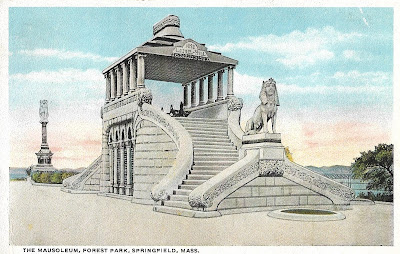
The Barney Mausoleum - Springfield, Massachusetts


Two postcard views of the Barney mausoleum in Forest Park, Springfield, Massachusetts.  The first, a photo from 1909; and the second, an illustration from the 1930s.  Inventor and industrialist Everett Hosmer Barney (1835-1916) was probably most famous for two things: inventing the clamp-on ice skate, and for the donation of 178 acres of his extensive estate to be added to Forest Park in the city of Springfield, Massachusetts.


In 1892, Everett Barney constructed this granite and marble mausoleum for his son on a Laurel Hill, near his Victorian mansion, which we discussed in this previous post. The mausoleum is the final resting place of Everett Hosmer Barney, his wife Eliza Jane Knowles Barney, and their son, George Murray Barney. The mausoleum has two sets of stairs leading up to a temple with twelve pink marble Ionic columns. 

---------------------

Jacqueline T. Lynch is the author of Comedy and Tragedy on the Mountain: 70 Years of Summer Theatre on Mt. Tom, Holyoke, Massachusetts; States of Mind: New England (collected essays from this blog); The Ames Manufacturing Company of Chicopee, Massachusetts; and Beside the Still Waters - a novel on the construction of the Quabbin Reservoir.

Tuesday, March 13, 2018

Talk on the Mill Girls - South Hadley, Massachusetts


"Sophie" photo by Lewis W. Hine, 1911, Library of Congress

In celebration of Women’s History Month, I will be presenting a talk on “The Mill Girls” - Wednesday, March 14, 2018, at 6:30 p.m. at the South Hadley Public Library.


At the dawn of the Industrial Age in the early nineteenth century, New England mill owners coincidentally spawned another economic revolution:  The hiring of thousands of young, unmarried women to work in the cotton, woolen, and silk textile factories.  A huge workforce was needed for the burgeoning mill towns, and women comprised the biggest untapped labor force in the United States.  The women changed the economy, they changed society, and they created new opportunities for themselves. Come follow the adventures of the mill girls of Chicopee, Holyoke, and South Hadley at the South Hadley Library, 2 Canal Street, South Hadley.  For more information, see the library website at: http://www.shadleylib.org, or call 413-538-5045.

Tuesday, December 5, 2017

Maude Tait - Aviatrix - Springfield, Massachusetts


Maude Tait, who was born in Chicopee, Massachusetts, in 1901, once beat Amelia Earhart in an airspeed race. She was one of the most successful and prominent pilots in a time when the word aviatrix called to mind a dashing figure in slacks climbing into an open cockpit of a wooden biplane, wearing a leather flying helmet, goggles, a long white silk scarf, and a smile as big as the sky. She was courageous, she was intelligent, and she was professional. An aviatrix had to be all these things to be successful.

Her father, James Tait, grew up on his parents’ farm on Chicopee Street. He and his three brothers eventually became very successful when they took over the farm in adulthood and established a dairy distribution business and also became a manufacturer of ice cream. They owned property in Springfield, and also in Agawam. They owned dairy farms and milk processing plants, and their sales territory spread out across New England and New York. Some of their milk and ice cream products were used on the White Star and Cunard steamship lines.

By the 1920s they employed over 500 people. However, in an interesting and perhaps, inexplicable to us, turn of events, the Tait brothers sold their business in 1928 in order to launch themselves into a new industry: the young and vibrant and promising aviation field. A farm in Springfield between Liberty Street and St. James Avenue became their launch pad for an adventurous new endeavor. They established the Springfield Airport with the intention of making Springfield an important aviation center, a hub in New England flight and manufacture of this new mode of transport.

Air travel was not yet common; indeed, only the very brave would risk their lives strapping on a parachute and hopping into one of the wooden crates. But visionaries, like the Tait brothers, foresaw a day when air travel would be a popular mode of transportation, perhaps even surpassing trains. Travel by automobile was not yet even considered a rival, because most roads in the U.S. were still poorly kept or even unpaved. A car trip across the country in those days before interstate highways or even paved roads, was at best inconvenient and at worst, dangerous.

The Tait brothers found another band of brothers to join in their new enterprise: the five Granville brothers. Originally from New Hampshire, the brothers Zantford, Robert, Mark, Tom, and Ed, were largely self-taught mechanics who, with the lauded Yankee ingenuity of the time, fashioned themselves into aircraft mechanics, designers, and even pilots; they wanted to set up a plant to produce their famous design of Gee Bee racing planes. “Gee Bee” or GB stood for the initials of Granville Brothers. Zantford, the oldest, was the leader of the group. But there was another notable member of their band, and she was the daughter of James Tait: Maude.

Maude attended Springfield’s McDuffie School for Girls among other seminaries, and began a career as a schoolteacher in a one-room schoolhouse in the town of Hamden, and also in East Longmeadow. She taught school until 1928 when her father and the Granville brothers set up shop on the old farm that was now the Springfield Airport. She had taken flying lessons in 1927 from Roscoe Brinton of the Curtiss Flying Service. Brinton would team up with another associate of the Granville Brothers, Lowell Bayles, to form a new flying service in Springfield. By 1928, when the Taits’ and the Granville brothers’ new enterprise “got off the ground,” she had achieved her pilot’s license as well as gaining a commercial pilot’s license. She was the first female to become a licensed pilot in Massachusetts and Connecticut to fly solo. In 1929 she set an unofficial altitude record for women at a height of 16,500 feet. An era of stunts and personalities, she flew an airplane over a football field and dropped the football from her cockpit for the kickoff at the Silvertown professional football season opener.

Two years later she would break Amelia Earhart’s speed record at 214.9 mph in her Gee Bee Sportster.

Maude Tait with Gee Bee Model Z

The Granville Brothers planes were built for speed and they used designs that were far ahead of any other plane of their time. Indeed, planes flown by the military in their fledgling air services were slower than the Granville Brothers planes. The distinctive snub-nosed Gee Bee some called a flying engine, and indeed was far advance of the skills of most pilots of the day.


The pinnacle of this happy band of pilots, designers, mechanics, and their Tait investment backers, and the adventurous Tait daughter, was the 1931 Cleveland Air Races.

Bob Hall was their chief designer; he and Lowell Bayles, and Zantford Granville, and Maude Tait, swept the championships in the week-long flying events. In those golden days around Labor Day 1931, Springfield was the capital city of aviation and the sky was the limit. Maude Tait for her part, won the Aerol Trophy race for women. She set a new record in the Gee Bee Model Y Sportster—and beat Amelia Earhart’s record by 10 mph. She missed hitting the men’s existing record only by 1 mph.

That was the high point. Unfortunately, the worst years of the Great Depression now set upon the country, and for those with dreams of starting a new business or expanding industry, it was extremely difficult to set plans in motion, or even to meet payroll. The Granville brothers engaged in these airspeed races not only for the prestige and the publicity to interest buyers for their planes and backers for their manufacture, but they needed the prize money just to keep things going.

It wasn’t enough. By 1934, the Granville Brothers closed shop and the Springfield Airport though it continued for still many more years, would eventually be replaced by a shopping plaza in 1959. Aircraft industry went elsewhere, and the plot of land, with its air strips of dirt and grass, was never big enough to accommodate the larger planes of the future, especially as it was hemmed in by residential neighborhoods on all sides.


A Gee Bee model returns for display at the Springfield Plaza, 1982, photo by J. T. Lynch

A Gee Bee model returns for display at the Springfield Plaza, 1982, photo by J. T. Lynch

Maude Tait married attorney James Moriarty in 1932. She had plans to participate in the 1932 National Air Races but mechanical difficulties sidelined her plane. That was the end of her competitive flying career. She would occasionally be seen flying her Gee Bee over the Pioneer Valley of western Massachusetts through the decade of the 1940s, but otherwise lived a quiet and private life. She died in Springfield in 1982, at 81 years of age.

We might wonder why the dream and the excitement of flying was so quickly extinguished, but the Great Depression had its chokehold on most people, and very few were able to continue their dreams in that desperate era. There was another reason, however, and it was even sadder, and more tragic, for two of her pals in that tight-knit Springfield Airport gang died in their Gee Bee planes. Only a few months after the glorious 1931 Cleveland Air Races, their friend and partner Lowell Bayles flew one of the Gee Bee planes to Detroit, Michigan, in an attempt to establish a world speed record. It was December, and he flew the Model Z Super Sportster. Lowell Bayles was clocked at 314 mph, breaking a record; but on the return run, he crashed.

A few years later, in 1934 Zantford Granville also met his death in one of their Gee Bee planes. We might well imagine that the venture collapsed because the money was gone, but we can well imagine, too, that the heart and soul of the enterprise was gone as well with the deaths of Bayles and Zantford Granville.

On that glorious day in 1931 when the Springfield Airport gang flew home after their streak of victories at the Cleveland Air Races, the scene occurred which still lives in the memories of the lucky remaining few who were there. For five days, the feats they achieved at the Cleveland Air Races were splashed all over the headlines of the Springfield newspapers. When it was time for them to come home, a crowd of over 100,000 mobbed the Springfield Airport to watch their heroes fly home. They flew home to a dirt and grass field, with that old ramshackle hangar that had used to be a dance hall, flying the fastest planes in the world.


They came in, one by one, first it was Lowell Bayles flying the plane christened the City of Springfield. An announcer called their names over a loudspeaker and the crowd cheered. Next it was Maude Tait in the red and white Senior Sportster, followed by Bob Hall, and finally, Zantford Granville. When Maude landed, cheers erupted, and people in cars parked on the edge of the field sounded their horns. Maude’s parents ran up to her taxiing plane and everybody rushed it, and she was handed a bouquet of flowers. There was a band and they were taken in a parade down Liberty Street down to City Hall. That evening there was a banquet at the Hotel Kimball. It was the high point of Springfield aviation in a time when people needed something to cheer about.

And one of the boys was an aviatrix named Maude Tait.

***********
A replica of one of the Gee Bee planes is on display at the Lyman and Merrie Wood Museum of Springfield History.

For a dramatization of the events, please see my one-act play written on commission for Springfield students, Soaring in the City of Springfield, courtesy of In the Spotlight, Inc., here.

Tuesday, October 15, 2013

New Book - The Ames Manufacturing Company of Chicopee, Massachusetts


Tomorrow, Wednesday, October 16th, I'll be speaking before the Chicopee Historical Society in the Community Room of Ames Privilege, lower Springfield Street, Chicopee, Mass. on three men who all worked at the Ames Manufacturing Company during the Civil War, and how the links and coincidences between them illustrate the Northern Civil War experience in a small factory town.  The event is free and open to the public.

Also, my latest book on the subject, The Ames Manufacturing Company of Chicopee, Massachusetts - A Northern Factory Town's Perspective on the Civil War will be for sale at the event.  It is also available in paperback from Amazon.com, Barnes & Noble.com, and CreateSpace.  It is available as an eBook through Amazon, Barnes & Noble, Smashwords, Apple, Kobo, Diesel, Sony and other online shops.


Tuesday, August 27, 2013

Hard Labor in New England


A few photos in anticipation of the upcoming Labor Day holiday.  Once upon a time, it meant more than the last backyard barbecue of summer.

The Fisk, Chicopee, Massachusetts, likely in the late 1930s.  Image Museum website.


Isaac Prouty Boot & Shoe Co, Spencer, Massachusetts, Spencer Historical Museum Collections. Richard Sugden Library, Spencer, Massachusetts.
 
 
Skinner Mfg. Co., Holyoke, Mass. Image Museum website.  See here for my previous posts on the Skinner silk mills: http://newenglandtravels.blogspot.com/2012/01/william-skinners-silk-mills-holyoke.html


War worker in 1942.  Gilbert Company, New Haven, Connecticut.  Photo Howard Hollem, Office of War Information.  See here for my previous post on women war workers:
 
 
Boys who worked at a cotton mill in North Pownal, Vermont, 1910. 
Lewis Wickes Hine, photographer, Library of Congress
 
 
Eastport, Maine, East Coast Canning Co., 1911,
Lewis Wickes Hine photographer, Library of Congress
 
 
Fiskeville, Rhode Island, Jackson Mill, 1909,
Lewis Wickes Hine photographer, Library of Congress
 
 
There but for the union go I.  Or you.  Happy Labor Day.


Tuesday, July 30, 2013

Clarence Brown - Autos and Movies


Clarence Brown, respected movie director during Hollywood’s glamour’s heyday, had a different career as a very young man.  How much influence the manufacturing city of Chicopee, Massachusetts, had upon his future choice of career in during the short time he lived here is unknown and probably negligible, but it is intriguing to observe how the fledging movie industry and the fledgling auto industry ran a parallel, and interdependent, course. 
Mr. Brown, before he ever knew what movies were, was employed by the Stevens-Duryea auto manufacturer in Chicopee.
Brown was born east of Chicopee in the town of Clinton, Massachusetts, in 1890.  The turn of the 20th century fast approaching, a menagerie of new innovations in science and art, and especially in new inventions, burst forth in such a stream of imagination that many qualities of the next century would find their prelude in this very decade. To narrow it down a little, both automobiles and moving pictures had their impetus in this frenetic decade called the Gay Nineties.
Both cars and movies have come to mean a great deal to us, and certainly to Clarence Brown.
While Brown was a small child, Frank and Charles Duryea were tinkering with their experimental gasoline-powered horseless carriage, the prototype for which was supposedly designed in their boardinghouse on Front Street in Chicopee. It didn’t take long for the auto industry to be off and running. The Overman Wheel Company in the section of town called Chicopee Falls was one of the country’s many new automobile factories; they were producing cars as early as 1900.
The men who designed and produced these marvelous machines were considered to be wizards of technology, dreamers, and rugged individualists. Clarence Brown may have fit into this mold, for surely he was a unique young man. Intelligent and gifted, he was allowed special permission to attend the University of Tennessee when he was only 15 years old.
While he studied engineering there, the threads of his future destiny were already forming for him thousands of miles away. In 1907, while Brown was away at college, the Duryea firm back in Chicopee contracted with the J. Stevens Arms plant in Chicopee Falls to produce their cars.
Stevens Arms company, postcard, Image Museum website, public domain
The following year the first movie theater in Chicopee opened. It was called the Gem, and it was located around the corner from the Stevens plant on Main Street. Any connection between these two newborn industries was unapparent at the time, and would even be to Brown at first.
His father, Larkin Brown, had run a cotton mill in Massachusetts, but when Clarence was a boy, the family moved south where his father continued in cotton textile manufacturing.  His father hoped that Clarence would go into the family business, but after graduating with two degrees at only 19 years old, the remarkable young man decided to follow his passion at the time—which was the new automobile craze.
He first went to Illinois to work at an automobile plant there, but soon came to Chicopee and the Duryea company around 1910.
Industry in the manufacturing town of Chicopee was diversified and booming at this time. Any number of products were produced here then, from foodstuffs to bicycles to clothing. Though we may think of the opportunities presented to the thousands of skilled and unskilled laborers who came here for work as represented by the huge influx of immigrants from Europe and Canada, Chicopee also became the proving ground for any number of professionals and “bright young men” who began their careers here.  One of them was Clarence Brown.
The Stevens-Duryea 1905 model
While Brown was working at the Stevens-Duryea auto plant, two more moving picture theaters opened up in the city. It would be tantalizing to think that Brown’s future fame as a director was born in a dark theater in Chicopee, but we’ll never know. Surely any interest he might have discovered in the flickers was put to the back of his mind, for about 1912 he left Chicopee. 
1912 advertisement
Brown is quoted in Kevin Brownlow’s The Parade’s Gone By…, “I became the traveling expert mechanic for Stevens-Duryea.  One of my calls was to a dealer in Birmingham, Alabama, who took a liking to me, and he set me up in a subsidiary company, called the Brown Motor Car Company. I had the agency for the Alco truck, the Stevens-Duryea, and the Hudson.  It was around this time—1913, 1914—that I became interested in the picture business.”
His favorite flickers at the time were produced by the Peerless Company, and Brown left Alabama and his business, and became an assistant to Maurice Tourneur, one of the directors for Peerless, whom he always credited with being his greatest teacher and directing mentor.
Years later Clarence Brown’s own films played in the new Chicopee theaters: the Rivoli, the Wernick, the Willow, and the Victoria—“second-run” neighborhood theaters which Brown never heard of because they were built after he left Chicopee.
Brown directed Greta Garbo in Anna Christie and Anna Karenina and five of her other films. His film A Free Soul made a star of Clark Gable, and his National Velvet introduced us to Elizabeth Taylor.  He gave us The Yearling, The White Cliffs of Dover, and Plymouth Adventure before retiring in 1953. He was nominated for a Best Director Academy Award five times.
Brown died in 1987 at 97 years old. Talent and ambition in one field brought him to Chicopee, but he made his mark in that other new industry in Hollywood.  And where would “the flickers” be without car chases?


A previous version of this article appeared in In Chicopee (a publication of the Holyoke Transcript-Telegram, Holyoke, Mass.) 1992.

Sources:
Brownlow, Kevin. The Parade’s Gone By… (University of California Press, 1976), pp.138-140.
Siegel, Scott and Barbara Siegel.  The Encyclopedia of Hollywood (NY: Facts on File, 1990) pp. 62-63.
Springfield (Massachusetts) Republican. September 19, 1937, p. 3E.
Thomas, Nicholas. Ed. International Directory of Films and Filmmakers: Directors, Vol. 7 (2nd ed. (Chicago and London: St. James Press, 1991), pp. 103-105.


Tuesday, July 16, 2013

Ladies Who Were W.O.W.s - Springfield Armory, Massachusetts


U.S. War Dept. photo, public domain

During World War II,  the Springfield Armory’s 50,000 employees worked around the clock producing 5,000 rifles per day.  At one point, 5,210 of the workers, 42.5% of the total Armory workforce were women.  They were called WOWs—Women Ordnance Workers.

When the men went to war, the women went to work, and several manufactures throughout the country hired women to replace the male workers gone into military service.  New England, a strong manufacturing base, already had a long history of hiring women for the textile mills of the 19th Century (See this previous post on mill girls), and now saw thousands of women in war plants and shipyards.  For many young wives of the World War II era, this was an opportunity to participate in the war effort and to earn a little extra income.  For many single girls, the war industries gave them their first jobs.  For the first time in as long as anyone could remember, there was plenty of work, and the pay was unlike anything they had ever earned.

There were only about 618 women working at the Springfield Armory before the war.  The making of small arms was the principal production.  The men those ladies were hired to replace during the war were skilled workers, many with years of experience on their jobs.  The shift over to a fair-sized force of new, inexperienced workers was not always a smooth one.  Adjustments had to be made in worker protocol, in safety measures, and in the very method of production. 

In peacetime, a man might spend four years in apprenticeship on his complicated machine; each operator was responsible for the setup and complete care of his machine.  In wartime, urgency required a streamlined operation.  The women operated machines while their male co-workers with the necessary experience would set up, repair and service the machines, as well as deliver heavy materials around the shop. 

Some adjustments were made in the shop to accommodate the ladies because new workers were very much needed.  Just as all those old wartime posters declared: swift and constant production was the key to victory.  The government set guidelines for manufacturers on dealing with the brand-new female workforce.  Separate adequate restrooms was an obvious first measure.  Chairs and stools at the machines were advised to cut fatigue, and special jobs were made available in the war industries to suit handicaps or with medical conditions such as heart trouble.  On-site cafeterias with hot meals saved time and energy, enabling the workers to avoid going out for lunch.  The Women’s Bureau of the Department of Labor advised an absence for pregnant women of six weeks before she delivered her child and two months after the child was born.  Some manufacturers preferred to fire pregnant women.  Many manufacturers including the Springfield Armory, at first were slack on Labor’s “equal pay for equal work,” but later the Armory revised pay rates to be based on the job performed and not on the sex of the employee.

Other recommendations many factories strictly enforced included banning the wearing of high heels, and encouraging the use of bandanas, hairnets or caps to protect the women’s hair from getting caught in the machines.  There had actually been some severe accidents, scalping really, and many women ultimately chose to emulate Hollywood star Veronica Lake, who cut her “peek-a-boo” over-the-eye blonde hair as a patriotic example to lady war workers. 
 
Wearing jewelry on the job was a hazard, and also a point of controversy, as newly married girls refused to take off their wedding rings.

Turnover at the Springfield armory was due mainly to exhaustion.  They worked fourteen days sometimes before getting a day off.  The Armory workers received one Sunday off a month.
 
The high turnover as well the absence of more senior male workers away in the war sometimes pushed women employees into higher positions, such as that of gang boss or even foreman.  In September of 1943, the Armory devised a special course for its foremen on the assembly and disassembly of their main product—the M1 Rifle.  The course was twenty hours, one hour a week set aside for the instruction.

Another factor to be considered in women’s participation in war industry was childcare.  The Works Progress Administration (WPA) supported free nurseries in the early years of the war, and when it was disbanded, individual communities later organized day care for the youngsters of their war workers.  Many Armory workers left their children ages two-and-a-half to four-and-a-half years of age across the street at the High School of Commerce, one of the many sites in the Springfield Day Centers for Child Care system.  Three dollars a week was charged for the nursery school, $1.50 for weekly care, and 15 cents daily for lunch.  Some of the high school’s home economics students participated in the nursery.

With all the difficulties facing the ladies entering this high-pressure, highly technical field of ordnance manufacturing, nevertheless, the ladies of the Armory, or WOWs – Women Ordnance Workers—were a vital and reliable source of “manpower” during a period of our history when many hands were needed. 

The ladies wore blue overalls, blue caps a mesh net for their hair.  To obtain these jobs they had to pass a civil service test, were examined by physicians, and submit to fingerprinting.  They earned an average of $125 a week, a marvelous sum for which they put up with long hours and an occasional blackout if they were on the “swing shift.” 

Sometimes, over the noise of their machines, they could hear the planes taking off from nearby Westover Field in Chicopee.  Even on the home front, the war was never really that far away.

For more on the Springfield Armory, have a look at this website.

And have a look here for the summer concert series at the Armory, including a World War II-era swing music night.


An earlier version of this article first appeared in Chickuppy & Friends Magazine, August 1986.

Tuesday, July 9, 2013

Doris Tanguay at the William Skinner Mfg. Co. - Part 2


Holyoke in the 1950s, Image Museum website


This is a continuation of our interview with Mrs. Doris Tanguay, who worked in the office of the William Skinner Manufacturing Company of Holyoke, Massachusetts, producer of silk textiles.  She worked there from 1939 through it's closing in 1961 when it was bought by another company.  See part one of the interview here.
World War II brought new challenges to the workforce at Skinner Manufacturing Company.

We all had quotas.  If you did war work, they gave you a quota for every month, so you had to keep track of everything.  Every month, the officer manager had to go to Springfield to the war office to get our quota for the next month.
And then of course, we sold bonds.  One of the girls, the girl that paid the bills, every Friday she would walk through the mill and give people their bonds, you know, when they had a bond paid up.  It didn’t take long.  I guess they were, like, $18 for a $25 bond at that time, something like that.  So she got to go through the mill every Friday and deliver the bonds that they would make out.
Photo supplied by Mrs. Tanguay; photographer unknown at this time.
 
After the war, Holyoke had a victory parade.  [Points to photograph]  That’s High Street in Holyoke.  You can see the name of some of the stores there.  Skinner’s had a float in it, and [her friend and co-worker] Rhoda was the bride on the float.  She’s got bright red hair, and with the white wedding gown, she was beautiful.  I’d been after her to give me the picture, because I want to give Wistariahurst a copy.  That would be great for them to put in that room where all the weddings gowns are, I think.
You know, when Pearl Harbor happened, we were very friendly with the Japanese.  They used to come, once a year the Japanese would come and they’d bring us presents, and they used to send us Christmas cards that were on silk.  And they screen printed on the silk.  I had saved some I gave to Wistariahurst.  What did I—I guess I gave that to Wistariahurst.  Last time they came, which was sort of ironic, they gave us all a silk American flag.  That was just maybe six months before Pearl Harbor.


But the minute that happened, the government, they didn’t seize it, but they put a stop on all silk, because we had to use it from them on for parachutes.  We couldn’t use it for anything else, and you had to give a report to the government, you know, how many pounds you had and so forth.  So, of course, that was coming to an end, the silk inventory they had, but in the meantime, the salesmen from DuPont came in with this new yard called nylon, which replaced the silk, and we made parachutes—parachute cloth, out of the nylon when the silk ran out.
Of course, we had that—we called it “tackle twill.”  It was originally made for Notre Dame football players.  They were always ripping their clothes.  So we had this cloth that was called tackle twill.  It was satin on one side, and cotton on the other side.  Very strong.  In fact, they made raincoats out of it, too, because they would put that stuff on that made it waterproof.  We sold a lot of that cloth for uniforms during the war. 
We used to have little guardhouses on the bank of the canal, right on the corner of the office, and we had guards with guns.  Three shifts, and we had a walk-in vault in our office.  When the guards left and the others came in, they would have to bring their guns in and put them in the vault, and the new ones coming on would come in and get the guns, and so forth. 
During the war, we lost a lot of our young men, you know, got drafted.  But they would write letters back to the company, and they would give us the letters to read and answer them.  So we were writing to soldiers.
Before my husband went overseas—we were married during the war—if he came home, my boss would say, “Go on, go on home.  Take the day off.” 

The Skinner employees would occasionally socialize with the management and Skinner family at non-work functions.
Image Museum website.
 
Mrs. Doris Tanguay:  Joe Skinner [son of the founder], I remember when he died very well [1946], because they asked some of us in the office to go up at the church to help.  You know, we put—they had certain pews that were reserved for people.  The reason I remember it is because Bill Skinner’s [grandson of the founder] wife, they later were divorced, she was working with us in the church and walking up and down in the aisles with a cigarette, smoking.  And I thought that was awful, because my father, who I told you worked at the church, he was the sexton, he said that Joe Skinner hated smoking.  He came to church one day when some workmen were putting in one of the stained glass windows, and one of them was smoking, and he fired him on the spot.  The minute he saw him, that was it.  And here they are smoking in the church at his funeral!
He [William Hubbard, grandson of founder?] had two daughters.  One was married to a guy from England, Tibbets.  But they were divorced.  In the later years, he bought her a house up at Wyckoff Park.  I don’t know if she’s still there or not.  Her married name was Tibbets.  I often wondered who ended up with their house at 90 North Pleasant Street, because his wife Dorothy was in the nursing home for many years.  She lived much longer than he.
He had another daughter, and we went to her wedding.  Everybody in the office was invited to the wedding at Fisher’s Island.  That was really something.  We had to go to New London, and it was during the war, and take a boat and go over to the island.  When we got to the island, we were met with cars from the—there was an Army station over there.  He had an in with them, because we had all these Army guys driving us around in the cars.  We couldn’t go to the church, because the church was too small for all the family and for guests, so we just were invited to the house.  So they would drive us around the island sightseeing to kill the time ‘til it was time to go to the house.  But we had a great time that day with all these guys from the Army.  You know, we were all young girls.
And we were all so worried about what we were going to wear.  And we all got new dresses, and before we got to New London, one of the girls drove.  We went to a side road, and we changed our clothes.  Put our new dresses on, because we didn’t want to be all wrinkled when we got there.
So then when we got there, people came in boats.  They were in shorts and bare feet.  Some other women came with furs.  It was in August.
And the champagne, they were spilling it all over.  We were walking in champagne on the floor.  It was really funny, because we were so fussy, and then when we saw what the other people were wearing, we felt we were okay.  Because a lot of them just came in boats.
And he had three boats, because he [William Hubbard] bought boats for each of his daughters, but I guess they weren’t as keen as he was on it.  Then they got married, of course, and left.  But he was so crazy about his boats, and his wife was scared.  She never went on one, the boats.  She didn’t want any part of the boats.
He [William Hubbard] was a nephew.  He was married to Dorothy.  She was a White, you know, from White & Wyckoff.  Dorothy.  She was very nice, too.  They were all so common.  Of course, I got stories from both ends.  At the church, they had this red carpet that they put down the middle aisle for the bride to walk on, you know, with her train and everything.  And every time there was a wedding, they would roll that carpet up and bring it down to the office, because we had these big vats.  When silk came from Japan, it had all this gummy stuff on it.  It was raw silk, and it had to be soaked before they used it.  So they had all these big vats.  So they would wash that red carpet in one of those vats and get it ready to go back.  Well, sometimes, they would put it on a little truck that would bring it up.  But if Bill Skinner [grandson of the founder] was around and he knew it was ready, he’d put it over his shoulder and he’d walk right up Appleton Street with it.  You know, he didn’t need to do that.  They were so common.  Really nice. 
Sometimes, somebody would have a party at their house.  I can remember one especially.  One of the young fellows that worked in our office lived in Northampton near the state hospital.  He had a garden.  One year when the corn was ready, they said they were going to have a party for the corn.  They were Polish, and his mother-in-law lived with him and she made all this great Polish food.  And we all went to his house for this party.  Bill Skinner had a convertible.  Bill Podolak [phonetic] was the name of the guy.  He had two small kids, and they were excited about the convertible.  So Bill says, “Hop in, we’ll go for a ride.”  He was there, you know, just as common as any of us.  It was really—and I think everybody that worked there really loved it.
Do you remember the Skinner Coffeehouse?  They tore that down a year or so ago.  I think it was Belle Skinner, back before my time.  [See this previous essay on Belle Skinner.]  They used to have a lot of young girls that left home and came to work.  They had a lot more women than men, of course, in there.  So Belle Skinner wanted a place for these girls where they would be safe.  So the Skinner Coffeehouse was built for these girls that were working in the mills.  And then when they didn’t use that anymore, they used it for community activities.  In fact, my husband told me he learned to dance there.
Then later on when they started having old age places, that was like the first one in South Holyoke, where they had things for the elderly.  It was a great place.  They had a lot of programs for children.  But then they tore it down.
Before they gave Wistariahurst to Holyoke, to the city, Stewart Kilborne’s [grandson of the founder] wife came to visit and she invited us, the girls, all of us girls for lunch at Wistariahurst and a tour before they turned the house over.  So we all went up for lunch and we got a tour of the house. 
Wistariahurst, Holyoke, Mass. - JT Lynch photo
 
My son is a musician, and Wistariahurst had this music room.  Dr. Hammond’s wife used to be in charge of it.  They had a piano in there that Napoleon gave Josephine.  They had a lot of original instruments, even from Africa.  The whole room was so filled with all kinds of—Will Skinner [son of the founder] used to travel the world buying silk.  He would pick these things up, and they gave that whole room, lock, stock and barrel, to Yale.  You know, most all the boys graduated from Yale.  But my son never got to see that room, but he would have been fascinated by it.  Now they have little concerts and stuff in there.
We had a big Christmas party in the Roger Smith [Roger Smith Hotel, Maple Street, Holyoke].  We always had a Christmas party.  We had something to do with the union.  We had a party, and Mr. Hubbard didn’t come to the Christmas parties, but he came to this union party.  No, he did come to the Christmas—oh, we used to have Christmas parties just for the office at—what was the name of it?  You know, it was like a zeppelin up on Route 5 going to Northampton?

 
1947 advertisement in "Valley Players" program, Holyoke, Mass.
 
DT:  Toto’s, yeah!  We used to have our Christmas parties there, and I used to love to dance with Mr. Hubbard [grandson of the founder], because he took dancing lessons in New York.  And he was a big man, and he was so easy to follow, because he almost lifted you up.  And he would always buy us—there’s a drink that they set on fire when they bring it to you. 
He always insisted he buy us that drink.  We looked forward to it.  Yeah, Toto’s, we had our Christmas party there. 

And then there was Don Purrington, who lived over in South Hadley on Woodbridge Street.  He used to, every year when the corn was ready, he would have a party at his house.  We’d have a corn roast, and that was always a big time too. 

We had lots of parties.  And then they would tell us about—you know, these old-timers would tell us about the old days.  The switchboard operator, she was there for over fifty years.  She lived up at the top of Sergeant Street, and she used to tell about the great balls they used to have at Wistariahurst when she was young.  She said they used to come down and hide in the bushes and watch the people come to the balls.  The women with all their beautiful dresses and everything.  She used to tell us all those stories.  We used to say, “Gee, we missed all that.” 


The William Skinner Manufacturing Company went out of business in 1961, bought by Indian Head Mills.  William Skinner first began operations in the 1870s.

Well, first they were going to sell to this Cheney Soap Company in New York.  But then Mr. Hubbard found out that they only wanted the name, you know, Skinner’s Silk and Satin was known all over the world.  And they were going to immediately close up the mill.  Well, they didn’t want the people to be without a job.  They wanted somebody to buy it who was going to run it.
So then Indian Head came along.  I don’t think they intended to keep us right from the very beginning, because they were going to keep Mr. Hubbard on, but he only lasted a month or so with them.  They brought somebody in to put over him and he was used to running the whole business.  We would have a great month, you know, a lot of orders.  “We’re going to have a good showing this month.”  Come the end of the month, we didn’t have a good showing; we had a loss because Indian Head owned a lot of other mills.  It was one of these companies that bought up companies that weren’t doing too well, and they would take it for the tax loss.
So they would take our profit.  I don’t know much about bookkeeping, but our profit they’d show on their books in another company.  So when we thought we had such a good month, we’d actually have a loss.  And then along the line they moved the office from Appleton Street across the canal to the mills that ran from Appleton Street over to Dwight Street.  And that entailed moving the switchboard, which was no small undertaking.  So we all said, “Oh, well, they’re going to keep us.  They’re not going to spend all this money and to do all this just to close us up.”  But, no such thing.  It wasn’t long before we saw the handwriting on the wall.
Inspecting.  Image Museum website.
Of course, Bill Skinner II was still around.  The last day that the mill was running—they knew all—it was like a big family.  All the men in the Skinner family, they would treat us like people, not, you know, now you’re a Social Security number where you work.  And he walked in the mill, he knew most of the people by first names, and he had tears streaming down his face.  The people are all crying.  It was a real sad day.
And of course, Mr. Hubbard thought he was going to stay with us, but he didn’t stay long.  They were just keeping him as a figurehead or something.  They brought their own man in.
I was there ‘til ’63.  The last day I walked through with the superintendent and we went through the sales room.  I don’t know whatever happened—there was still cloth left in the sales room where that went.  But there was a wedding gown, and he said, “You might as well take this because,” he said, “I don’t know what’s going to happen to all this stuff.”  He said, “They might just throw everything away.”
So I took the wedding gown, and I thought my niece might wear it, but it wasn’t her style and I had it wrapped up and kept it for many years.  Then I said, “Well, guess I’ll give it to Wistariahurst.”  So, they have it at Wistariahurst now.  They have one room at Wistariahurst with just bridal gowns on models all over the room.

A fire in 1980 destroyed much of what had been the Skinner plant.

Mrs. Doris Tanguay:  That took everything but the new mill.  That mill stretched from Appleton Street to Dwight Street, but at the end, the very last, that was a fairly new mill.  They saved that, and that was where the Children’s Museum went in the park.  But the other parts, well, they were the original mills.

[Mrs. Tanguay displays a colorful quilt made by her mother from Skinner fragments.]

Mrs. Doris Tanguay:  When we were kids, we had quilts that my grandmother made, one for me and one for my sister, and we used them, and we wore them out.  I wish I had them today. These were all sample pieces.  And you the back—Indian Head owned a mill up in North Adams.  They made drapery material and they started sending down to the salesroom.  I bought some of it, and this is what she used for the backing.  When you think of, you know, a lot of it’s hand-work.  It shows Indian Head as well as ours.  I just hate to part with it, but I told the kids, I said, if you do anything with that, you can always give it to Wistariahurst.
When you think of the old machine that she had.  I never even could use it.  When we were kids she [her mother] used to crochet our dresses.  I was never any good at that.

I love talking about Skinners. You know, after I left there, I went across the street to Technifax.  They were in the old American Thread building, and I worked at Technifax, and they were sold to Scott Paper, who also bought Plastic Coating over here in South Hadley. 

Then Scott Paper sold to James River.  I worked twenty years for them, but they weren’t Skinners, but they weren’t bad.  Especially the Technifax part.  I had to learn a whole new thing.  In textiles, they have all their own terminology.  And then you go in a paper mill—well, actually, it was a coating where they made film.  That’s another all new terminology.  But I was always lucky.  I always had good bosses.  I never had one that I didn’t like. 

My sincere thanks to Mrs. Doris Tanguay for sharing her memories of, and her affection for, her working years at the Skinner Manufacturing Company of Holyoke, Massachusetts.
***
I am interviewed here at "A Blue Million Books" blog by Amy Metz on writing, and on my cozy mystery Cadmium Yellow, Blood Red, here.


Now Available