No post this week. See you next Tuesday.
Tuesday, April 24, 2012

Tuesday, April 17, 2012
Titanic Centennial Memorial - Springfield, Massachusetts
This coming Saturday, April 21st, the Titanic Historical Society of Indian Orchard, Massachusetts is dedicating a new memorial to two of the victims of the sinking of the RMS Titanic. Oak Grove Cemetery in Springfield is the site of the Titanic Centennial Memorial.
Two individuals from Springfield were lost in the tragedy: Milton C. Long, the only son of a former mayor of Springfield, who was 29 years old; and Jane Carr, who was an Irish-born domestic and cook, 47 years old. She had worked in Springfield, and at the Chicopee Falls Hotel. Long was a first-class passenger, and Carr was third class.
Milton Long’s body was recovered and is buried in Springfield Cemetery. It is unknown if Carr’s remains were ever recovered.
Edward S. Kamuda, president and founder of the Titanic Historical Society, began the organization and unique museum of artifacts after seeing the “Titanic” 1953 film at the Grand Theater in Indian Orchard. More on the museum here in this previous post. For a look at the 1953 film, visit yesterday’s Another Old Movie Blog post here.
Tuesday, April 10, 2012
Fenway Park at 100

Funny how the oddest images can become iconic. Kenmore Square, Boston, a "big oil" advertising sign peeps over the treetops. Baseball fans in New England will recognize the sign from another vantage point: from inside the walls of Fenway Park.

Closer now, just outside the park on game day. Banners of previous glories heralding a tradition to cling to in other years of little glory. There have been a few of those.
Fenway Park turns 100 years old on April 20th.

The park, more so than with other major league teams, represents the heritage of the team, the fans, and the game, and is so identified with the Boston Red Sox that where other teams have a stadium, the Red Sox, and its fans, have a home.

For more on the 100th anniversary celebrations, have a look a the official Boston Red Sox website. For photos of decades gone by, have a look at this interesting site.
Tuesday, April 3, 2012
NOW IN PAPERBACK...

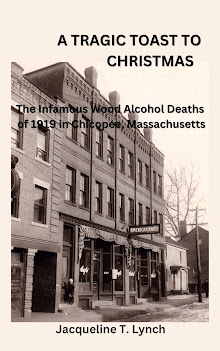
The book will shortly by offered online at Amazon, and in the weeks to come by Barnes&Noble and other distribution outlets. The book is immediately available through CreateSpace. Right here.
Or, you can order the book directly from me. There are two ways:
Method number one: Just scroll all the way down to the bottom of this blog...no, farther. ALL the way down to the cellar where I keep the music that plays when you hit this blog, and my summer clothes, and the Christmas decorations. And the furnace. All the way down. There you'll see a box where you can order the book through PayPal and credit cards. The price is $12 (but for subscribers to my newsletter, $10), plus postage. There's a blank for a name if you want me to inscribe it to somebody.
Method number two: If you want to pay by check or money order, just send your request to JT Lynch, PO Box 1394, Chicopee, MA 01020. Either in your order or by email, send me the subscriber's code in your recent newsletter if you're paying the discounted price.
Also, let me know in your order or by email (JacquelineTLynch@gmail.com) if you want a signed copy. If you also want it inscribed to someone ("To Sam", "To Shirl", "To Grandma Teitelbaum", to "Chief Inspector Dave"), just let me know. Please restrict the inscriptions to names only. I prefer not to address books to "Pooky Bear" or more intimate derivations thereof. Please remember I am a New Englander and terms of endearment therefore embarrass me.
Tuesday, March 27, 2012
A Stroll from New Hampshire to Vermont

A little walk from New Hampshire to Vermont involves a little bridge. Here we begin in Hanover, New Hampshire in the northern part of the state.


Across the Connecticut River in Norwich, Vermont, we come upon the site of a first settler, cabin long gone. Only the historical marker to tell the tale.


Tuesday, March 20, 2012
Summer Theatre - Connecticut, 1950

On the official last day of winter, it may be a bit early to mention summer theatre. This is the time, however, for seasons to be planned, auditions scheduled, and an enormous amount of off-stage work that has to be done before the slights go up in the barn this July. Here’s a look at four summer theaters in Connecticut and their offerings in August 1950.
The 1950s, with the help of the automobile and post-war disposable income, bloomed as a heyday of New England summer theatre. These ads from The Hartford Courant show the Canton playhouse, which was a barn at the juncture of routes 177 and 44, where Noel Coward’s “Tonight at 8:30” featuring a “professional cast” wowed the patrons of a summer evening. This was produced by the Show Shop company run by Stanley and Joan Cobleigh, who founded the group around 1940.
Nearby Unionville put on “Cradle Song” at the Town Hall, next up, “The Philadelphia Story”.
Down by the Sound, Clinton Playhouse, boasting of air conditioning -- not something you’d usually find in summer theatre -- featured Charles Quigley in “the recent Broadway success” of “The Magnificent Yankee”. Seats running anywhere from 70 cents to $2.40.
Over at Ivoryton, the Playhouse featured Raymond Massey in “Our Town”. According to the New London Day, August 15, 1950, Mr. Massey’s stepdaughter, Dorothy Whitney, made her stage debut as Emily. Also in the cast were Jane Seymour, Dorrit Kelton, Arthur Walsh as George, Hal Courier and Leonard Lord. “Several curtain calls at the end attested the quality of the performance,” recorded the reviewer, George H. Grout.

Of this wealth of summer stock, I believe only Ivoryton is still going strong today, and as a year-round theater. According to its website: “...the Ivoryton Playhouse became the first self-supporting summer theater in the nation. Older theaters as in Dennis, MA, and Skowhegan, ME, were not self-supporting, but endowed by foundations of wealthy families.” The Ivoryton Playhouse opened in 1930, with Bette Davis trodding the boards. Katharine Hepburn spent a season of several shows here, and many Hollywood names performed on its stage.
For more on the Ivoryton Playhouse, have a look at this website. For more on the Canton’s Show Shop productions, have a look at this article by Sylvia Cancela.
Tuesday, March 13, 2012
Irish Famine Memorial - Boston

The Irish Famine Memorial depicts two families and the schism between the old world and the new; the horrific past, and a hopeful future.
Two sculptures by Robert Shure show two families. One suffers the agony of the Great Hunger. The other family tentatively takes its first steps on American soil, representatives of the great Irish diaspora that caused millions to leave their homeland to escape death.

Part of Boston’s Freedom Trail, located on Washington and School streets, the bronze and granite memorial was dedicated in June 1988 to commemorate the 150th anniversary of the Famine. One and a half million Irish emigrated to America during the famine years.

For more on the memorial, have a look at this website. For more on sculptor Robert Shure, have a look here.
Subscribe to:
Posts (Atom)