Affiliate notice

Affiliate links may be included in posts, as on sidebar ads, for which compensation may be received.
Showing posts with label houses of worship. Show all posts

Tuesday, April 18, 2023

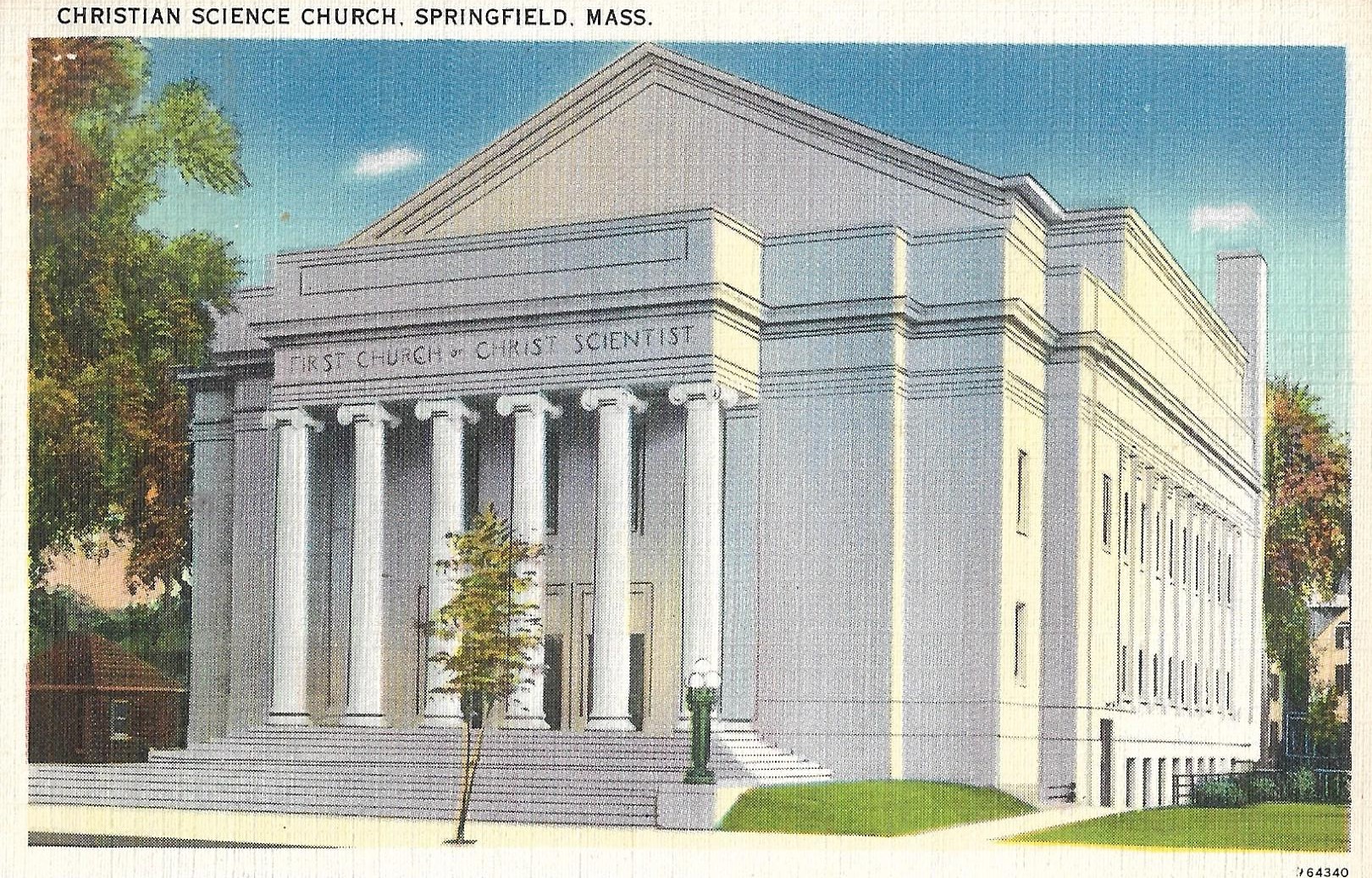
Christian Science Church building - Springfield, Massachusetts


The Christian Science Church of Springfield, Massachusetts, stood on State Street in this 1930s-era colored postcard.  The postcard was published by the Springfield News Company.


The congregation merged with another in Longmeadow sometime around 2000.  The site is now the Progressive Community Baptist Church.

******************

Jacqueline T. Lynch is the author of The Ames Manufacturing Company of Chicopee, Massachusetts - A Northern Factory Town's Perspective on the Civil War;   Comedy and Tragedy on the Mountain: 70 Years of Summer Theatre on Mt. Tom, HolyokeMassachusetts;   States of Mind: New England; as well as books on classic films and several novels. Her latest book is Christmas in Classic Films. TO JOIN HER READERS' GROUP - follow this link for a free book as a thank-you for joining.

Tuesday, January 10, 2023

First Baptist Church - Springfield, Massachusetts


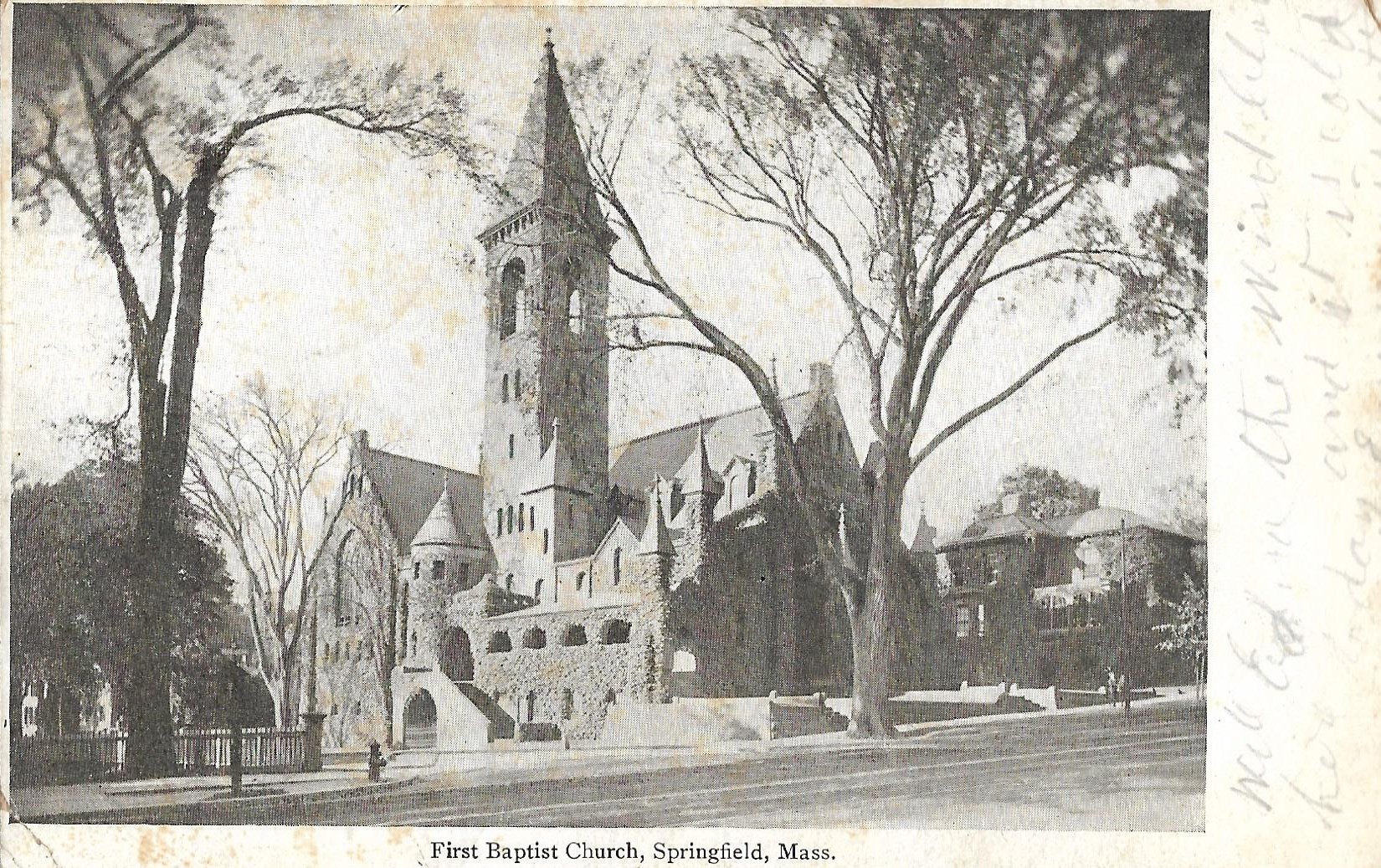
Here are two postcard views of the First Baptist Church of Springfield, Massachusetts.  They are from 1907 and 1908.  The Romanesque building is the fourth church used by this congregation and stood on the corner of State and Spring streets.


The church was used for nearly 20 years, then the congregation merged with the Highland Baptist Church (whose own building on Stebbins Street burned down in 1906) becoming First-Highland Baptist for a time, and afterwards the building was sold and became St. Paul's Universalist Church.  It no longer exists, replaced by a parking garage.

******************

Jacqueline T. Lynch is the author of The Ames Manufacturing Company of Chicopee, Massachusetts - A Northern Factory Town's Perspective on the Civil War;   Comedy and Tragedy on the Mountain: 70 Years of Summer Theatre on Mt. Tom, HolyokeMassachusetts;   States of Mind: New England; as well as books on classic films and several novels. Her latest book is Christmas in Classic Films. TO JOIN HER READERS' GROUP - follow this link for a free book as a thank-you for joining.

Tuesday, December 20, 2016

Washington's message on the Touro Synagogue


George Washington visited the oldest synagogue in this nation (founded in the 1600s) at Newport, Rhode Island.  His remarks on the Touro Synagogue are a reflection of, and support for, the new Bill of Rights.

“...every one shall sit in safety under his own vine and figtree, and there shall be none to make him afraid.”

He wrote this in August 1790.
"For happily the Government of the United States gives to bigotry no sanction, to persecution no assistance, requires only that they who live under its protection should demean themselves as good citizens, in giving it on all occasions their effectual support."
He meant it.  We should mean it, too. 

Happy Hanukkah and blessings to all our countrymen of all faiths.

Tuesday, March 17, 2015

St. Patrick's Day 1920s Theatricals - Holy Name Church, Chicopee, Massachusetts


The Annual St. Patrick’s Show was a fundraiser of the kind seldom seen anymore: a community theatre, in this case, a church drama club, whose aspirations went no further than homemade costumes and props in the church hall, a show put on by friends and neighbors, and a bit of the luster of show biz for the price of a 50-cent ticket.

And Billy Disappeared was a comedy put on St. Patrick’s week at the Holy Name Hall on South Street, Chicopee, Massachusetts, in 1923.  The following year it was another comedy, Professor Pepp, billed as “A Farcical Comedy with a College Flavor in Three Acts.”  Oh, the flashy times and witty repartee of the Roaring Twenties.


 As evidenced in this page from the program, these types of plays featured large casts, because as any community or church theatre group knows, large casts means lots of relatives in the audience.

In those days, it certainly meant large Irish families. 

The next year, March 1925, they performed The Whole Town’s Talking, which surely they must have been, over the riotous vaudevillian gusto of another big cast made up of members of the congregation, including defectors from the choir, Ladies’ and Men’ Sodalities, and some seniors from Holy Name High.


This tight little world on South Street was the Holy Name of Jesus Church, founded in 1857, the oldest Roman Catholic church in western Massachusetts, the mother church of the Springfield Diocese.  A grammar school and high school and convent were once part of that little world.  Unfortunately, the church was closed temporarily in 2011, and continues to be closed indefinitely at this point, due to repairs needed for structural issues.  The parish continues actively at another church around the corner, Assumption of the Blessed Mary Church.


The thespians, their antics, and their intermissions of Irish songs, are from another era when hokum, sentiment, and amateur theatrics were beloved for all their imperfections, when two players not married to each could fluster the straight-laced regular churchgoers with a stage kiss, and when St. Patrick’s Day was a time for innocent, and entirely homemade, showmanship.

Tuesday, November 25, 2014

Harvest Supper - Granby, Massachusetts

Image Museum website


It was too early for Thanksgiving, but the ladies of the Congregational Church of Granby, Massachusetts served their harvest supper at the end of September 1915, with "special attention to Automobile and Carriage Parties."  Fifty cents buys you a chicken pie, and a quarter extra for the three-act comedy, "Mrs. Briggs of the Poultry Yard."  Heck of a deal.

Tuesday, October 21, 2014

Old Graveyard - Pelham, Massachusetts


Formerly part of Prescott, where some of Daniel Shays' men plotted rebellion in the years following the American Revolution.   The building is the Pelham Historical Society, once a Congregational church built in 1840, restored and serves as a museum, open in the summer months.

The old graveyard headstones stand sentinel during those sweet, balmy days when sunshine warms Pelham Hill...and on dark, chilly, Halloween nights.


Tuesday, April 29, 2014

Park Street Church, Boston

 Photo by J.T. Lynch

On the corner of Tremont and Park Street, the Park Street Church is a stop on Boston's Freedom Trail.  It was founded 1809.


 Photo by J.T. Lynch

Until 1846, it was the tallest building in the United States.  Its stature, however, was based on other things:  on Pastor Edward Beecher (brother to Harriet Beecher Stowe) who promoted the ideals of Abolition.  To perhaps the most noted abolitionist of his day, William Lloyd Garrison, who spoke out against slavery here.

Photo by J.T. Lynch

It was here the song "My Country 'Tis of Thee" received its first public performance in 1831. How odd, that such a place of tumultuous thought and deed could now provide a quiet corner of tranquility in this otherwise bustling city.

For more on this historic church and its still active congregation, have a look at their website.

Tuesday, February 19, 2013

Church of the Presidents - Quincy, Massachusetts


In acknowledgment of Presidents Day yesterday, today we visit Quincy, Massachusetts and the United First Parish Church, which is also locally called The Church of the Presidents.  Both President John Adams and his son, President John Quincy Adams worshiped here.  They, along with their First Ladies, are buried in a family crypt below the church.
Grave of John Adams & Abigail Adams
The Greek Revival church, built in 1828 is also called The Old Stone Temple, as it is constructed of granite, much of which was donated by John Adams from a quarry site on land he owned.  It was designed by Alexander Parris, who also designed Boston’s Quincy Market.

Grave of John Quincy Adams & Louisa Catherine Adams

The congregation was established in 1636, and this is the fourth meetinghouse constructed.

For more on this beautiful and historic church, visit this website.

Tuesday, December 25, 2012

Peace Be With You


Park Street Church, Boston, in warmer days.

A very Merry Christmas to those who celebrate it, and a Happy New Year to all.  In appreciation for the pleasure of your company this past year, I’m offering my eBook collection of essays from this blog, “Classic Films and the AmericanConscience” here from Amazon for free Christmas Day through the 27th.  This will be the last time this book is offered free; in the new year it will be available not only through Amazon but also through Barnes & Noble’s Nook, Apple, Sony, Diesel, Kobo, and Smashwords.
I’m going to take a couple weeks off to tend to some other business, but I’ll be back in late January.  I hope you can join me.
This is going to be a difficult Christmas for many who have suffered tragedy and loss this year; and for the people of Newtown, Connecticut, December will never ever be the same. 
 
A few weeks ago on my "Another Old Movie Blog", I blogged about “Cry Havoc” a movie which takes place in the Philippines during World War II.  I was reminded by many images through that film of my father. 
My father entered the Army in December 1942 and missed Christmas at home that year.  He had a wife and a new baby.  He was sent to the Pacific Theater of operations and island-hopped with all the rest of the gang, and Christmas of 1943 passed by, and then Christmas 1944.
There were no telephone calls home, no emails, only letters and tiny “V-Mail” notes that took weeks to get home.  He sent Christmas messages home in early November, hoping they would make it in time.
In the summer of 1945 he was in the Philippines, and endured horrific experiences he did not like to talk much about.  He also got malaria, which stayed in his bloodstream so that he continued to suffer a bout of it after he got home.  There were other injuries and wounds, but good news came when the Japanese surrendered, which was totally unexpected for regular GIs like my dad, who were convinced they’d be spending 1946, 1947, and 1948 still fighting the war. 
Now that peace was declared, his only enemy was time.  He wanted to get back home for Christmas 1945.
 
He had earned enough points to be rotated home.  Several weeks on a troop ship.  He passed under the Golden Gate Bridge in San Francisco, which was the last thing he saw of the US when he left.  Now that he saw it again, he really believed he was home.
A few days being processed, and more days on the train because he lived on the other side of the continent.  After being in the jungle for three years, winter in the US was a shock, and his first telegram home contains the line, “COLD COUNTRY.” 
Leave it to a New Englander to squeeze in a comment about the weather in his first telegram to his wife.
Finally he arrived at Ft. Devens in the eastern part of Massachusetts, and a few more days of the mustering out process.  Medical exam, paperwork, ribbons and commendations, a clean uniform to home in, and finally a “ruptured duck” lapel pin to wear. 
But he lived in the western part of the state, so it was another train ride.  He sat in the station in Boston, waiting for his connecting train, and ate at a lunch counter.  The man behind the counter gestured to his ribbons and said, “You’re money’s no good here, son.  You’ve done enough,” and wouldn’t let him pay.
Decades later, my father still felt grateful, humbled, and embarrassed by the moment.
When the train pulled into the station, his wife and daughter were there on the platform.  His daughter wasn’t a baby anymore, but a little kid running around.  She had been told many times that the man in the portrait photo at home in the uniform was Daddy.  She got mixed up and thought anybody in uniform was Daddy and had to be told over and over again that, no, that’s not Daddy.
Finally her mother points to a tall, handsome guy stepping off the train and says, “There’s your Daddy.”  I’m thinking my sister, with all the wisdom of a small child thought, “Yeah, right.  Tell me another one.  I’m not falling for that again.”
It was January 1946.  He failed to get home for Christmas. 
In his last telegram he wrote “SORRY ABOUT THE HOLIDAYS.”  A real man sometimes apologizes for what isn’t even his fault.
My father was in his early 20s when he left.  He had fired weapons in war, but the experience did not make a man of him.  He was man because he had a family and took responsibility for them.  Responsibility is what made him a man, and he knew it.  He was good marksman, but he looked down on people who needed guns to make them feel manly, or make them feel safe.  It was a crutch for cowards, he thought.
I was tempted to use as a graphic and ad here published by an assault weapons manufacturer that inferred that manhood would be achieved by ownership of their product.  However, I refuse to print any words or images on this blog that are obscene.  That image and the message behind it are obscene.
My parents lost four Christmases, and the years ahead would not be easy.  As anybody knows, happy endings are only for movies.  But they accepted what they could not change, and tried to be resilient, and change what they could.
The people of Newtown must accept what they cannot change.
The rest of us must change what we can. 
Now.
 
Peace be with you.
Tuesday, December 20, 2011

It Came Upon the Midnight Clear

“It Came Upon the Midnight Clear” first appeared in print as a poem in the Boston Christian Register, a few days after Christmas in 1849. Edmund Sears, pastor of the Unitarian, First Parish Church in Wayland, Massachusetts wrote it.

Sears was originally from the western Massachusetts town of Sandisfield. The following year, 1850, composter Richard Storrs Willis wrote the tune that is most often played to this song in the US. (The United Kingdom has another melody to this song.)

Here is the poem Mr. Sears wrote that became one of most popular traditional Christmas carols:

It came upon the midnight clear,


That glorious song of old,


From angels bending near the earth,


To touch their harps of gold:


"Peace on the earth, goodwill to men,


From heaven's all-gracious King."


The world in solemn stillness lay,


To hear the angels sing.


Still through the cloven skies they come,


With peaceful wings unfurled,


And still their heavenly music floats


O'er all the weary world;


Above its sad and lowly plains,


They bend on hovering wing,


And ever o'er its Babel sounds


The blessèd angels sing.


Yet with the woes of sin and strife


The world has suffered long;


Beneath the angel-strain have rolled


Two thousand years of wrong;


And man, at war with man, hears not


The love-song which they bring;


O hush the noise, ye men of strife,


And hear the angels sing.


And ye, beneath life's crushing load,


Whose forms are bending low,


Who toil along the climbing way


With painful steps and slow,


Look now! for glad and golden hours


come swiftly on the wing.


O rest beside the weary road,


And hear the angels sing!


For lo!, the days are hastening on,


By prophet bards foretold,


When with the ever-circling years


Comes round the age of gold


When peace shall over all the earth


Its ancient splendors fling,


And the whole world give back the song


Which now the angels sing.


For more on the First Parish Church in Wayland, established in 1640, have a look at this website.

Tuesday, July 26, 2011

Flags in the Old North Church - Boston, Massachusetts


Inside Boston's Old North Church the flag of New England, and the flag of the United States (when there were quite a few less states).  The bold colors of the flags stand out from the pristine white of the ceiling and columns, and the pure white natural light coming in from the clear windows.  We always equate the Old North Church with Paul Revere's famous ride during the opening days of the Revolutionary War (see this previous post here). 

But it's modern day solace, quietly keeping the faith and the heritage, is just as monumental, if more serene.

Tuesday, March 8, 2011

First Church (Center Church) of Hartford, Connecticut


Life is often both dignified and comical at the same time. While I would not suggest that the small church pictured here is funny, dwarfed as it is by a larger glass and steel office building, but one may smile all the same at the stubborn refusal of the outdated past to shirk away from the bold and brassy present. I would not call the modern structure “the future”, because it may not be standing in the future. The church however, I would certainly bet on.

It’s already been standing since 1807.

The First Church, or Center Church, of Hartford, Connecticut holds a long and respected place in Connecticut history. It’s first pastor was Thomas Hooker, who when trudging off into the New England Wilderness after a dispute with John Winthrop, Governor of the Massachusetts Bay Colony, founded Hartford on the Connecticut River in 1636.

In the past 375 years, four buildings have served the congregation. The first was a log building where the Old Statehouse stands today. The third structure, built in 1739, stood where the present church stands today. The present meeting house has stood here since 1807, (at the dedication, the congregation was treated to the first performance in Hartford of the “Hallelujah!” chorus from Handel’s Messiah.)

A church welcoming of other faiths, it allowed the first Roman Catholic Mass in Hartford to be celebrated in this building in 1813.

With a few additions and renovations in the last couple of hundred years, the meeting house has weathered a far greater test of time than the shadows thrown from taller, newer buildings.

The bell in the steeple was cast in England in 1633. It still rings out on Main Street.

For more on the First Church or Center Church of Hartford, have a look at this website.

Tuesday, September 28, 2010

Quaker Meeting House - Yarmouth, Massachusetts


The Friends Meeting House in Yarmouth, Massachusetts was in use by the local Quaker community for a century from 1809 to 1909, but then awakened from dormancy in 1955 by an active Quaker community.

After World War II, newcomers started to call Cape Cod home, and among these a growing number of worshipers of the Society of Friends, who also joined Quaker communities established in nearby towns of Sandwich and Falmouth.

This Yarmouth Meeting House, which along with an adjoining one-room Quaker schoolhouse are on the National Historic Register, continue to serve the community with “silent” worship services (this meeting house has never in its history had a minister), and First Day School for children and adults.

For more on the history of Quakers on Cape Cod, have a look at this interesting website.

Have a look at this previous post for more on the Quaker Meeting House in North Adams, Massachusetts on the other end of the state.


And so I find well to come
For deeper rest to this still room
For there the habit of the soul
Feels less the outer world's control
The strength of mutual purpose pleads
More earnestly our common needs;
And from the silence multiplied
By these still forms on either side,
The world that time and sense have known
Falls off and leaves us God Alone.


Friday, August 13, 2010

Wells-Ogunquit Historical Society


Route 1 through southern Maine seems more built-up each year with new businesses, and summertime traffic. Here in Wells, the Historical Society of Wells & Ogunquit observes the changes through the windows of the Meetinghouse Museum.

It’s the old First Congregational Church, on the National Register of Historic Places, over 140 years old, but continuing service in a new way for a town that is now 357 years old. New development on Route 1, whatever it brings, is just a blink of the eye in the timeline of this seaside community.

The museum here contains various exhibits on daily life throughout history, and illustrates the changes and opportunities that the people of the Wells-Ogunquit area witnessed or created by hand for themselves.

For more on the Meetinghouse Museum and the Historical Society of Wells & Ogunquit, Inc., have a look at this website.

Friday, April 2, 2010

Happy Easter


With this being Good Friday and Easter fast approaching, here’s another look at the impressive Old First Church of Bennington, Vermont, last seen in this post. Happy Easter.

Friday, February 12, 2010

Old First Church, Bennington, Vermont


Here on Route 9 in Bennington, Vermont is the Old First Church, formed by separatists from Connecticut and Western Massachusetts, and is today considered Vermont’s Colonial Shrine.

The organizers were "Separatists," influenced by the Great Awakening, from Connecticut and Western Massachusetts in the 1760s. This church building dates from 1806. That it was the first church in Vermont dedicated to the separation of church and state is no small thing, and deserves a visit for that as much as for a look at the beautiful architecture.


Poet Robert Frost is buried in the churchyard here, another reason for a pilgrimage here, and we’ll have more about that another time.


For more on the history of this church and congregation, have a look at the Old First Church website.


Tuesday, January 26, 2010

First Congregational Church - Gardner, Mass.


The First Congregational Church in the central Massachusetts town of Gardner was built in 1878. This distinctive brick Victorian gothic church and clock tower, in style very much a symbol of its era, replaced what would have been a much more simple-looking, traditional original meeting house, built in 1787.

For more,  have a look at this website.

Friday, December 18, 2009

Enough Rum to Build a Meeting House - Northampton, 1737

In 1737, some fellows building a new meeting house in Northampton in the western part of the Massachusetts colony, consumed 69 gallons of rum, 36 pounds of sugar, and several barrels of beer and cider in one week, presumably on their union-mandated breaks and lunchtime. Okay, no union. Not yet.

This likely would have been the Third Meeting House in Northampton, the Congregational Church under Reverend Jonathan Edwards at the time, just a few years away from his famous and frightening sermon, Sinners in the Hands of an Angry God.

After listening to that, it’s likely one would have needed a drink. Hopefully, they had some left.

Tuesday, September 29, 2009

Union Meetinghouse - Storrowton Village


The Big E is underway and in full swing, but taking a break from the bustle of the crowded fairgrounds, we have a look at one of the quieter spots of the Eastern States Exposition, the Union Meeting House at Storrowton Village.

For those not from New England, the Exposition is an annual regional, rather than a single state fair, representing all six New England states. (See this previous post on the Eastern States Exposition.)Storrowton Village is a re-creation of a 19th century New England village common on the fairgrounds with representative buildings placed around it to illustrate what life was like in such a place, at such a time. The “Village” may be fanciful, but the buildings are not recreations. They are actual historic buildings moved here as part of a project headed by Helen O. Storrow, and were collected from 1927 to 1931.


This church is the Union Meetinghouse, built originally in cooperation between four separate denominations in the Smith’s Corner section of Salisbury, New Hampshire in 1834. These denominations shared the building between them. It was moved here to the Exposition fairgrounds in West Springfield, Massachusetts in 1929. The pulpit, and the bell, are salvaged from other churches in New Hampshire and Massachusetts.

Today, wedding ceremonies may still be held in this non-denominational church. The steeple towers over the village, and vies with the nearby Ferris wheel for attention. The Ferris wheel is only temporary, though. The church weathers the centuries, and the fairgoers, with equal fortitude.

For more on Storrowton Village, have a look at this website.

Tuesday, July 28, 2009

Quaker Meeting House - Adams, Mass.


A cool breeze, a brilliant blue morning sky, and hilltop Quaker meeting house in Adams in the Berkshires of western Massachusetts becomes at once a thing of sacred stillness, and a communion with the past.


It is vacant now, maintained by descendents of those first Quaker settlers who established this township once called East Hoosuck, but it is owned by the Adams Historical Society, and so the place of worship has become a place apart, the centerpiece of a colonial graveyard, and an artifact of town history.

This denomination of the Society of Friends moved here from the area around Dartmouth, Massachusetts and Smithfield, Rhode Island in the late 1760s. The meeting house dates from 1782.

At that time their beliefs, which varied from opposition to slavery, to war, and to the equality of men and women to a degree that was unknown among non-Quakers, as well as their silence services in which each person is allowed to be guided by his own “inner light” rather than a church or clergy to bring them closer to God, were cause for the Quakers to be persecuted. In the 1600s, they were hanged on Boston Common.

In this quiet and peaceful spot they were removed from that horror, but did not shut themselves off from the injustices of the world. They promoted the humane treatment of prisoners and the mentally ill. They extended their friendship to the Indians, and to slaves. Massachusetts had abolished slavery in 1790, but it was still permitted in New York until 1826. Several runaway slaves from New York State found refuge here among the Quakers.

The Friends also engaged in another bitter aspect of society, and one which was for them especially agonizing. Despite their espoused opposition to war, some Quakers from this community fought in the Revolutionary War at the Battle of Bennington in nearby Vermont. Below the meeting house, among a cluster of headstones, there is a memorial boulder on which a plaque is dedicated to those Friends, “laying aside their religious scruples took up arms in defense of their homes and liberties.”

The struggle of scruples for Quakers on this point was recently discussed in a review of “Friendly Persuasion” on my Another Old Movie Blog.

A total of 40 Quaker families lived and gathered for meeting here in 1819, and afterwards there was a decline in membership as more and more members of the community headed west as pioneers, even as their ancestors headed west from Rhode Island and eastern Mass. The last official Quaker meeting took place here in 1842.

The old Indian trail called the Pontoosuck Path is now Friend Street that leads up to the hill on which the Meeting House is perched. Look above the rooftop to the massive Mt. Greylock, and the observation tower that looks down, from the highest point in Massachusetts, that can just be seen. One remote world still silently observing another.

For more on the Adams Quaker Meeting House, have a look at this website.

Now Available