Affiliate notice

Affiliate links may be included in posts, as on sidebar ads, for which compensation may be received.
Showing posts with label colonial period. Show all posts

Friday, July 4, 2025

Independence Day - Countdown to the Semiquincentennial...


We New Englanders just marked in June the 250th anniversary of the Battle of Bunker Hill.  This flag of New England was flown and carried on the battlefield in 1775.  At the end of the year 1775 the first Continental flag was adopted...


And it would be another couple of years before we put aside pine trees and the Union Jack in the corner and replace them with stars of varying designs.  But it was a start, and so we make a start to celebrate a most prestigious year ahead with our Semiquincentenial as a nation.  At this juncture, it would be appropriate to review several of the complaints made against King George III as written in our Declaration of Independence.  They are well worth noting:


He has endeavoured to prevent the population of these States; for that purpose obstructing the Laws for Naturalization of Foreigners; refusing to pass others to encourage their migrations hither, and raising the conditions of new Appropriations of Lands.

He has obstructed the Administration of Justice, by refusing his Assent to Laws for establishing Judiciary powers.

He has made Judges dependent on his Will alone, for the tenure of their offices, and the amount and payment of their salaries.

He has erected a multitude of New Offices, and sent hither swarms of Officers to harrass our people, and eat out their substance.

He has kept among us, in times of peace, Standing Armies without the Consent of our legislatures.

He has affected to render the Military independent of and superior to the Civil power.

He has combined with others to subject us to a jurisdiction foreign to our constitution, and unacknowledged by our laws; giving his Assent to their Acts of pretended Legislation:

For Quartering large bodies of armed troops among us:

For protecting them, by a mock Trial, from punishment for any Murders which they should commit on the Inhabitants of these States:

For cutting off our Trade with all parts of the world:

For imposing Taxes on us without our Consent:

For depriving us in many cases, of the benefits of Trial by Jury:

For transporting us beyond Seas to be tried for pretended offences…

******************

Jacqueline T. Lynch is the author of The Ames Manufacturing Company of Chicopee, Massachusetts - A Northern Factory Town's Perspective on the Civil War;   

Comedy and Tragedy on the Mountain: 70 Years of Summer Theatre on Mt. Tom, HolyokeMassachusetts;

 States of Mind: New England

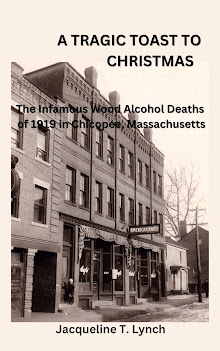
A Tragic Toast to Christmas -- The Infamous Wood Alcohol Deaths of 1919 in Chicopee, Mass.; as well as books on classic films and several novels.  Her Double V Mysteries series is set in New England in the early 1950s.  

TO JOIN HER READERS' GROUP - follow this link for a free book as a thank-you for joining.

Tuesday, June 27, 2023

Westfield River -- Agawam, Massachusetts


Here are three postcard views of the Westfield River in Agawam, Massachusetts.  They are all published by the Springfield News Company and printed in Germany, as was common in the early twentieth century.  The cards all date from around 1908, and are tinted.


You'll note that on the cards the river is called the Agawam River.  The earliest English settlers to the area named it that for the Agawam tribe that lived in the area, but eventually came to be called the Westfield River.  It begins in the Berkshires and ends in the Connecticut River, forming the boundary between the towns of Agawam and West Springfield.


Despite these idyllic scenes, by the mid-twentieth century the river became terribly polluted, as many of our rivers were through industrial contaminants, but today is clean for swimming, fishing, and its locally famous Westfield River Whitewater Races.

Tuesday, September 4, 2018

Walking tour and talk on The Puritan statue - Springfield, Massachusetts

photo by J.T. Lynch

I'll be leading a walking tour in Springfield, Massachusetts this coming Saturday, September 8th from the Puritan Statue on State Street to Stearns Square, and then to Court Square to discuss Puritans and Artisans.


Sponsored by the Armoury-Quadrangle Civic Association, the walk will be about a mile in distance, and a few centuries in time. We will discuss the sculptor - - Augustus Saint-Gaudens; the foundry craftsman and sculptor who created Springfield's Civil War statue - - Chicopee's Melzar H. Mosman (about whom I'm currently writing a book); about the landscape architect for the first site of the Puritan statue on Stearns Square - Stanford White; about Chester W. Chapin, the descendant who gifted the stature of his ancestor to the city; and about Deacon Samuel Chapin himself, "The Puritan."


Join us at the Springfield Library and Museums visitor's center at 10:30 a.m. 

Tuesday, November 24, 2015

Mayflower Compact - Plymouth, Massachusetts


To all our American readers, Happy Thanksgiving.

Tuesday, May 27, 2014

Woodstock and Windsor - in the Middle of Vermont


A ride through Vermont today, and a few views from the middle of the state.  Above, here's the common and town center of Woodstock.


Across from the common is where you drop your letters to Santa.  But not this time of year.  A relic akin to the old hitching post.


Eastward and nestled beside the long Connecticut River (Connecticut actually meaning: long tidal river), is the town of Windsor, where we take advantage of a good day for some spring planting.

Both towns are in Windsor County, both have populations of a bit over 3,000 people, but one thrived in the Industrial Revolution, and the other remained largely agricultural.  Windsor is where those rebellious free thinkers wrote themselves a Constitution, broke off from Mother England, and declared the Republic of Vermont.

We previously covered the Windsor-Cornish Covered Bridge here, one of the longest covered bridges in the world, where you can slip over to New Hampshire if you want to.  Go ahead, I'll wait.

Tuesday, July 3, 2012

Bunker Hill Monument - Charlestown, Massachusetts


Pausing to chat, a couple of Colonial soldiers visit with the statue of one of their leaders, Major General Joseph Warren here inside the monument at Bunker Hill.

The battle in June 1775 was actually won by the British, but it was a hollow victory. They lost many more men, and the Colonials -- specifically the militias of Massachusetts, Rhode Island, Connecticut, and New Hampshire -- proved they could stand up to the British regular army.  They carried the flag of New England, which you can see in this previous post.

Warren, who had received his promotion to Major General only days before, had actually fought as a volunteer private. He was President of the Massachusetts Provincial Congress, and his death was a great loss to the Colonials. Historical artist John Trumbull depicted the event in his famous painting: The Death of General Warren at the Battle of Bunker's Hill, June 17,1775.

Original in collection of Museum of Fine Arts, Boston.  Photographic reproduction in Public Domain.

Happy Independence Day. Remember what it cost.


Tuesday, June 5, 2012

Old Granary Burial Ground - Boston


The small boy dressed in Colonial clothing striding across the Old Granary Burial Ground is not a ghost, even though the modern-dressed boys in the background don’t appear to see him.


Here on Tremont Street in Boston, the burial ground dates from 1660, and among the famous names you’ll see on some of the headstones is John Hancock and Paul Revere. You might meet the occasional historical interpreter as well, dressed appropriately and giving you a tour.

Unless it’s a ghost.


For more on the Old Granary Burial Ground, have a look at this site.


Tuesday, March 27, 2012

A Stroll from New Hampshire to Vermont


A little walk from New Hampshire to Vermont involves a little bridge.  Here we begin in Hanover, New Hampshire in the northern part of the state.


Across the Connecticut River in Norwich, Vermont, we come upon the site of a first settler, cabin long gone.  Only the historical marker to tell the tale.


Tuesday, August 23, 2011

Constitution House - Windsor, Vermont


Here at Elijah West’s tavern in Windsor, Vermont along the Connecticut River, the locals decided in July of 1777 to make this place a free and independent republic. There were a few things to iron out of course, land grants claimed by New Hampshire across the river, and claims by New York on the other side (independence from its neighbors more than independence from Great Britain was the main issue at this stage), and then this whole Revolutionary War hullabaloo. Also, a few months earlier it was decided in a preliminary vote to call the whole prospect “New Connecticut”.


But (we may presume) over a tankard or two, they got down to business and decided that Vermont would be the name (a derivation of the French verd mont -- green mountains), and that their constitution would be a bit different to what had been hammered out by the other states. Vermont was the first to outlaw slavery, and to assure universal voting rights for men whether or not they owned property. Vermont was also the first to establish free public schools.


Having got that out of the way, it was another decade after the Revolutionary War ended that they got around to shedding their Republic and joining the United States in 1791. Vermonters like to be sure, and they seem to have decided the USA was going to work out all right.

For more on the Constitution House, now a museum, have a look at this website.

Tuesday, June 7, 2011

America's Stonehenge - Salem, New Hampshire

It is a mystery, still being discovered. “America’s Stonehenge” in Salem, New Hampshire is a site of caves and rock formations, and stone placements that appear to be an astronomically aligned calendar marking, and predicting, lunar and solar events. It is at least 4,000 years old, and is reckoned to probably be the oldest man-made structure in the United States.

We do not know who set these stone formations, but a variety of artifacts from a variety of eras in mankind’s timeline in North America are found here.

Stone tools, pottery, stone and bone pendants, artifacts from ancient Native Americans, and from the Colonial period. This site was also used, because of its caves and its isolation, as a hiding place on the Underground Railroad in the 19th century.

There are over 350 such megalithic sites in New England, and we are learning more about them. Prior to archeological study in the 20th century, they were only hidden spots, or known about through local legend and tales, and gossip. Strange things seen there, strange things imagined. We’ve passed through the era of myth and legend into the age of discovery, and this brings with it newfound awe and wonder for a people who lived here long ago.

The property on which this megalithic site sits is a private outdoor museum, and open to the public year-round. Have a look here at the website for more information.

Tuesday, March 8, 2011

First Church (Center Church) of Hartford, Connecticut


Life is often both dignified and comical at the same time. While I would not suggest that the small church pictured here is funny, dwarfed as it is by a larger glass and steel office building, but one may smile all the same at the stubborn refusal of the outdated past to shirk away from the bold and brassy present. I would not call the modern structure “the future”, because it may not be standing in the future. The church however, I would certainly bet on.

It’s already been standing since 1807.

The First Church, or Center Church, of Hartford, Connecticut holds a long and respected place in Connecticut history. It’s first pastor was Thomas Hooker, who when trudging off into the New England Wilderness after a dispute with John Winthrop, Governor of the Massachusetts Bay Colony, founded Hartford on the Connecticut River in 1636.

In the past 375 years, four buildings have served the congregation. The first was a log building where the Old Statehouse stands today. The third structure, built in 1739, stood where the present church stands today. The present meeting house has stood here since 1807, (at the dedication, the congregation was treated to the first performance in Hartford of the “Hallelujah!” chorus from Handel’s Messiah.)

A church welcoming of other faiths, it allowed the first Roman Catholic Mass in Hartford to be celebrated in this building in 1813.

With a few additions and renovations in the last couple of hundred years, the meeting house has weathered a far greater test of time than the shadows thrown from taller, newer buildings.

The bell in the steeple was cast in England in 1633. It still rings out on Main Street.

For more on the First Church or Center Church of Hartford, have a look at this website.

Tuesday, October 26, 2010

Springfield WitchTrials

Some forty years before the infamous Salem Witch Trials, a husband and wife were put on trial for witchcraft in Springfield, Massachusetts. They were innocent of witchcraft, but one of them was guilty of murder.

It happened in 1651. Hugh Parsons was a bricklayer on lower Main Street, who by his neighbors’ accounts, could be a bit moody at times. A neighbor woman, named Blanche Bedortha, criticized Mr. Parsons in some manner, and he retorted with the threat, “I shall remember you when you little think of it!”

The ruffled Goodwife Bedortha blamed Hugh Parsons for the sudden zing of static electricity she felt on her nightgown, since no one knew what that was or had a scientific explanation for it. She claimed he hexed her.

Then his second child, Joshua, died, and Mrs. Parsons’ went insane. The neighbors accused Mr. Parsons of having murdered the child. Mrs. Parsons did not help much when she, by now hysterical, confessed that she and her husband both were witches. Hugh was her third husband. I don’t know what she thought of her earlier two husbands.

Hugh got it from all sides now, as neighbors blamed everything from a cow’s having no milk, to cuts, nightmares, and minor illnesses on him being a witch.

Hugh was arrested and marched by the constable through the streets, and taken to Boston where the trial was held. The court found him guilty of witchcraft.

Fortunately for Hugh, about this time, Mrs. Parsons pulled herself together and confessed that she killed her son. They sent her to Boston for trial. Hugh was set free in May 1652. Mary was convicted of murder. All charges of witchcraft were dropped, possibly because things had just gotten too complicated and everybody was probably sick of the Parsons by now.

On the morning she was to be hanged, Mary was found to be too ill to be taken from prison. She died in her cell the next day.

Hugh never returned to Springfield, and may have left Massachusetts. He probably couldn’t wait to leave.

Tuesday, May 11, 2010

Rocky Hill-Glastonbury Ferry - Oldest Ferry Service

This quiet little river crossing is the ferry on the Connecticut River that links Rocky Hill with Glastonbury in Connecticut. It is the oldest continuously operating ferry service in the United States, some 355 years this year.

If you were on the road hereabouts in 1655, you could cross on the raft, propelled by the crew using long barge poles. They tried using a horse on a treadmill once, and then steam power in the 1870s, but today you’ll cross on the barge called the Hollister III, towed by a diesel-powered flatboat, the Cumberland.

She holds three to four cars or trucks (depending on the size of the vehicle) at a time, and if you’re fifth in line, why you just wait your turn. Plenty of people do, as the ferry makes between 80 and 100 crossings a day, especially at rush hour. “Rush” hour may not be exactly the right word, but if you’ve got ants in your pants, that’s just too bad for you.

It’s $3 per vehicle, and $1 for walkers or bicyclists. The ferry runs from May 1st through October 31st. There is no service in the winter. The river tends to freeze. Tough to get the boat through. You understand.

But, it’s May now, so as with so much in life, enjoy it while you can.

For more on the Rocky Hill-Glastonbury Ferry, have a look at this website, and this one, too.

Tuesday, April 20, 2010

Adams National Historic Park - Quincy, Massachusetts


Since yesterday was Patriot’s Day in Massachusetts (and Maine), let’s have a look at some genuine patriots. We have endured many ersatz self-proclaimed ones of late.

Adams National Historical Park tells the story of four generations of the Adams family (from 1720 to 1927). The park has two main sites: the birthplaces of 2nd U.S. President John Adams and 6th U.S. President John Quincy Adams, and also Peace field, which all together were home to four generations of the Adams family

At the corner of Franklin Street and Presidents Avenue in Quincy, Massachusetts, there stand companionably close together two small salt-box style houses that date from the 1700s. John Adams was born in the older house, the weathered-looking, unpainted structure, in 1735. In the painted newer house, closer to the road, he lived with his wife, Abigail, whom he married in 1764.

That was all before he became President, before these roads were ever named Franklin and Presidents streets, before the town of Quincy came into being. This was still part of Braintree then. Today these two homes on this triangular plot of land form an island in otherwise noisy, hectic sea of 21st century traffic, high tension wires, and convenience stores. Yet, here it is still, believably, the 18th Century.

John Adams wrote in his diary a year after his marriage, on Thursday, December 26th, 1765, “At Home by the Fireside viewing with Pleasure, the falling Snow and the Prospect of a large one.”

It was a peaceful moment in the otherwise dramatic, tumultuous, and history-making life of the farmer-lawyer who rode circuit on his horse through all kinds of weather, snow included. As the years progressed, he would take a leading role in a Revolution, forge ties as a diplomat between Europe’s oldest monarchies and this new American country that was the first democratic republic in the world. He would become its first Vice President, and its second President, and his own son would be the 6th President.

Another house, about a mile away, is the more genteel manor President Adams and his remarkable wife Abigail moved to in 1788. Here they would spend their retirement years, and several generations of their family maintained the property until these three sites were turned over by the Adams descendants to the National Park Service in 1946. This country estate is called Peace field.

The Adams National Historical Park, which comprises these three homes in Quincy is a view not only on American history, but of its culture and artistry, and its ingenuity. There are thousands of artifacts here from the Adams family, including works of art, a library of over 12,000 volumes, furniture, and Abigail’s old bullet mold. She had melted down her pewter spoons to mold into bullets for the Continental Army.

John and Abigail Adams’ dramatic adventures during the Revolution and presidential years were chronicled in historian David McCullough’s “John Adams”, which won the Pultizer Prize and was made into the critically acclaimed HBO miniseries in 2008. In that year, after the miniseries was shown, the Adams National Historical Park was overwhelmed with visitors who had suddenly discovered John Adams through that program and now wanted to re-visit him and Abigail again in the best place that was possible.

Now that the crowds visiting these three homesteads have thinned out, it’s a great time to visit. Also down the street is the United First Parish Church where both President John Adams and President John Quincy Adams, and their ladies, are buried. More on that another time.

For more on the Adams National Historic Park, have a look at this website. For more on the HBO miniseries, have a look here.

Tuesday, April 6, 2010

Earthquakes in New England

Devastating earthquakes, most recently in Haiti and in Chile, draw our sympathy and response with aide to the anguished people suffering these mysterious events, and renew our curiosity about the peculiar horror of shaking earth.

The recent earthquake in the Baja Peninsula reminds earthquake-prone areas that these natural phenomena are always a factor. New England has its own, obviously much milder, history of earthquakes. An earthquake off Cape Ann, Massachusetts was noted by future President John Adams in his diary on November 18, 1755:

We had a severe Shock of an Earthquake. It continued near four minutes. I was then at my fathers in Braintree, and awoke out of my Sleep in the midst of it. The house seemed to rock and reel and crack as if it would fall in ruins about us. Chimnies were shatter’d by it within one mile of my fathers house.

It was fairly severe quake, and knocked the weather vane off the roof of Faneuil Hall in Boston. That month the plates under the Atlantic Ocean seemed particularly active, as earlier that month on November 1st, the city of Lisbon, Portugal was destroyed by an earthquake.

It is conjectured that the earthquake recorded in 1638 was an even bigger one, scaring the Puritans silly. Another famous diarist, John Winthrop, noted many aftershocks in the following weeks.

We’ve since had a fair scattering of smaller quakes through the late 1800s and 20th century, one of the larger probably being the January 10, 1982 quake that reached about 5.9 on the Richter Scale, followed by several days of minor aftershocks and a second quake on the 19th, reaching 4.8. Another that hit Quebec and was felt in all New England states occurred November 1988, reached 6.0 on the Richter.

During those shaky moments, diners at the Top of the Hub restaurant on Boston’s Prudential Center got as rattled as the dishes; the ceiling shook at the old Boston Garden where the Celtics were just about to play the Milwaukee Bucks; and in western Mass., the old 10-story control tower at Westover Air Reserve Base was evacuated.

Hardly the stuff of disaster such as what victims of very destructive earthquakes must endure. We wouldn’t want it any other way.

Friday, January 29, 2010

Settler's Rock - New Shoreham, Block Island


New Shoreham is the smallest town in the smallest state. This memorial, called Settler’s Rock, dedicated in 1911, commemorates the 250th anniversary of the purchase of Block Island and settlement here in 1661. The plaque lists all the names of the settlers. Think of it as an early directory.

For more on New Shoreham, Block Island, Rhode Island, have a look at this website.

Tuesday, December 1, 2009

The Pilgrims and the Printing Press


Before we leave Thanksgiving behind us for another year, let’s recall that one of the items brought to the New World on the Mayflower we believe was a printing press, a large iron piece of which was used to shore up a splitting beam on the voyage.

The Mayflower Compact was handwritten, but this replica of the 1669 printed copy shows the printing press was just as instrumental at founding, and preserving, an equitable nation as the bonds of commonwealth established by the Mayflower Compact.


This 1723 printing of the Thanksgiving proclamation by the Lieutnant Governour and His Majesty’s representative in Massachusetts Bay boldly ends with the typical flourish GOD Save the King. While the Pilgrims may not have quite gone along with that, they might have been still more amazed at the level of freedom which a free press achieved, and would continue to thrive in a democracy the likes of which they never conceived.


Here is the Massachusetts Spy out of Worcester in 1775, only a few weeks after the Battle of Lexington and Concord, when “God Save the King” was replaced by “Liberty or Death!”


Here we have a less incendiary newspaper from Northampton, Mass. in more placid times of 1826, and from Holyoke, Mass. in 1882, when we see the dawn of the 20th Century brought advertising to a more prominent place in the media. The Holyoke Transcript, later the Holyoke Transcript-Telegram, has followed the path of many newspapers of the last twenty years and is now defunct.


Today we are losing our newspapers with alarming rapidity, but communication continues in its myriad forms. Keeping an open mind rather than choosing to read only news which pleasures but does not challenge, and opinion in which we are already in agreement is the worst form of tyranny, because it is self imposed. We seem to need to re-learn that every once in a while through the centuries.


These printing press photos are from Sturbridge Village. Go have a look at the printer plying his trade.

Tuesday, August 25, 2009

Presidents on Martha's Vineyard


President Barack Obama’s family vacation on the island of Martha’s Vineyard will play big in the news this week, but perhaps the Vineyard residents, even the tourists, may take it in stride after all. President Bill Clinton’s family vacations here through the 1990s gave them a little practice in dealing with the traffic of tedious motorcades and tight security. Other sitting US Presidents, and would-be presidents, and former presidents were visitors here, under vastly different circumstances.

For a detailed retrospective on these presidential visits, have a look at this article in Martha’s Vineyard magazine.Two that spring to mind as the most interesting, and in some ways coincidental (not just because they were also in August) and ironic as times of political turmoil, are when John Adams came for a court case in 1765. Lawyer Adams rode circuit at the time and the Vineyard was part of his jurisdiction.

In his diary, John Adams wrote, “After the 14 of August this Year 1765, I went on a journey to Martha's Vineyard, on the Tryal of a Cause before Referees, between Jerusha Mayhew and her Relations. The keen Understanding of this Woman, and the uncontroulable Violence of her irascible Passions, had excited a quarrell of the most invidious, inveterate and irreconcileable nature between the several Branches of the Mayhew Family, which had divided the whole Island into Parties.”

The “uncontroublable Violence” of “irascible Passions” was nothing compared to what was going on back in Boston as Adams waited to board his ship in Falmouth for the crossing to the island. His cousin Sam Adams, really annoyed at the Stamp Act, led the Sons of Liberty to riot against the stamp master on August 13th, and then on the 26th, burned down the fellow’s house. The Act had been voted on in Parliament that March, but wasn’t even going to take effect until November.

John Adams briskly summarized, “I forgot to mention that while We were at Falmouth waiting to be ferried over to the Island the News arrived from Boston of the Riots on the twenty fifth of August in which C.J. Lt. Governor Hutchinsons House was so much injured. My Business at the Bar was so The Stamp Act was repealed, and the Declaratory Act passed: but as We expected it would not be executed, good humour was in some measure restored.”

Well over one hundred years later in the nation that Adams helped to establish,
President Ulysses S. Grant and his wife visited the Vineyard in August 1874 at the Methodist Campgrounds. He was the first sitting U.S. president to visit the Vineyard. The previous year, the Panic of 1873 (they don’t call them Panics anymore even if we still panic a little), brought economic ruin when banking firms collapsed, the stock market crashed, and the depression that resulted (we don’t even like to call them depressions anymore if we can help it), lasted a good six years.

In the congressional elections that fall after President Grant’s vacation, the Democrats (Grant was a Republican you remember), took the House for the first time in many years in one of our many typical political shudders as a response to trouble.

These days we, too, are experiencing “uncontroulable Violence of…irascible Passions,” exciting “a quarrell of the most invidious, inveterate and irreconcileable nature.” Perhaps a little vacation is what we all need. May “good humour” in some measure be restored.

For a look at the town of Oak Bluffs, have a look at my article on Another Old Movie Blog on the Strand Theater. For a look at John Adams’ autobiography, see this site by the Massachusetts Historical Society.

Tuesday, March 17, 2009

Colonial St. Patrick's Day

Though St. Patrick’s Day has become identified with Irish nationalism and Roman Catholic observance of a saint’s day, this holiday’s origins in America were Protestant and British.

It began in Boston in 1737, and for the rest of the story, allow me to refer you to my article posted at Suite101.com on the colonial St. Patrick’s Day.

Tuesday, December 2, 2008

One by Land, One by Sea


Two state capitals, one view by land and the other by sea, were established at roughly the same time. The Dutch trading post on the Connecticut River begun in 1623became a thriving English colony a decade later. The pennisula settled in 1625 became the City on a Hill and to future generations, the cradle of liberty.


Hartford has the oldest continually published newspaper in the country, the oldest art musuem. Boston has the oldest school and the oldest college. Somewhere along the way, Saukiog became Hartford and Shawmut became Boston, and both are wrapped in confusing ribbons of superhighways now. Parking might still be a challenge, but getting to these cities has never been easier.

Been there to the Freedom Trail or the Wadsworth Atheneum? Let us know.

Now Available